
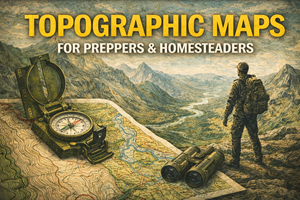
The “terrain truth” tool that still works when GPS and the internet don’t
Topographic maps are one of the most valuable preparedness tools you can own because they show the world the way it actually is — not just where roads happen to be. If road maps are “how people move,” topo maps are “what the land will allow.”
For preppers, topo maps help you plan movement, avoid traps, find water, and understand how terrain shapes risk. For homesteaders, topo maps are a land-intelligence tool: drainage, frost pockets, wind exposure, sun angles, and where your property will fight you over time.
And when the internet goes down, topo maps don’t degrade. They don’t need towers, satellites, or apps to make sense. A paper topo map and a compass still work when everything else is quiet.
What a topographic map is (in plain language)
A topographic map is a detailed map that uses contour lines to show elevation — the hills, ridges, valleys, slopes, and flat areas that determine how water flows and how hard travel will be. It also usually includes natural and man-made features like rivers, lakes, roads, trails, buildings, and boundaries.
The key difference between topo maps and most digital navigation is that topo maps give you context. They don’t just tell you where something is — they show what’s around it, what’s above it, what’s below it, and what could block you.
In preparedness terms: topo maps turn “I think we can go this way” into “I know what that route demands.”
Why topo maps matter for preparedness
1) Terrain controls movement (more than people realize)
In stressful situations, people underestimate how much terrain matters. A road might be closed. A bridge might be out. A detour might turn into a dead end. Suddenly you’re walking or rerouting — and the land becomes the deciding factor.
Topo maps help you avoid:
- routes that look short but climb aggressively
- gullies and steep drainages that slow you down
- “easy-looking” areas that are actually impassable when wet
- bottlenecks where everyone will funnel
When you can see terrain, you can choose routes that match your reality — fitness level, gear load, weather, time window — instead of gambling.
2) Topo maps help you find and judge water
Water is not just “where the creek is.” Water is:
- where it comes from (upstream)
- how it moves (drainage)
- how reliable it is (seasonal vs year-round)
- how accessible it is (steep banks vs gentle access)
Topo maps show the land shape that creates springs, streams, and drainages. You can often infer where water will collect even if a stream isn’t marked clearly. That’s huge for both bug-out planning and homestead water strategy.
3) They reveal “quiet danger zones”
Topo maps can expose risk that a normal road map hides:
- flood-prone low ground and basins
- narrow canyons that become traps
- steep slopes prone to slides
- routes that require crossing difficult terrain
- areas with limited visibility or limited exit options
You don’t need to be paranoid to benefit from this. This is just making calm decisions with better information.
Why topo maps matter for homesteaders (especially long-term)
Homesteading is basically a long-term partnership with your land. If you misread the land, it will correct you — slowly, expensively, and repeatedly.
Topo maps help you plan:
- Drainage: where water will pool, where it will cut channels, where erosion will happen
- Building placement: avoiding low spots, unstable slopes, or areas that become mud every spring
- Gardens and orchards: slope, sun exposure, and frost pockets
- Roads/driveways: grades that are manageable year-round
- Wind exposure: ridgelines vs sheltered pockets
A topo map won’t replace walking your property — but it will make your walking smarter. It helps you see patterns you might miss in the first year.
The one topo skill everyone should learn: contour lines
Contour lines connect points of equal elevation. Once you get the hang of them, they become incredibly intuitive.
Here’s the practical breakdown:
- Lines close together = steep (hard travel, faster runoff, greater erosion)
- Lines far apart = gentle slope / flatter ground (easier travel, more stable building sites)
- Closed circles = hilltops or depressions (depending on markings)
- V-shapes in contour lines usually point upstream in valleys/drainages
You don’t need to become a cartographer. You just need to look at a map and quickly answer:
- “Is this route climbing hard?”
- “Where does water naturally go?”
- “Where would travel be easiest if the road is blocked?”
That skill alone is preparedness gold.
What topo maps help you do (real prepper use cases)
Route planning with realistic energy math
Topo maps make it obvious when a “shortcut” is actually a punishing climb. In preparedness, time and energy are resources. You want routes that are:
- stable
- predictable
- doable with your current capacity
Choosing fallback locations that won’t trap you
A location that looks remote and “safe” on a road map might be trapped by terrain — one canyon road, one bridge, one way out. Topo maps reveal those traps early.
Building a smarter bug-out plan
Topo maps help you pick:
- multiple routes with different terrain profiles
- alternate crossing points
- high-ground options if flooding is a concern
- routes that avoid predictable funnels
Understanding visibility and concealment
Topo maps show ridgelines, valleys, and terrain breaks. That matters for:
- observation
- avoiding being silhouetted on a ridge
- choosing travel lines that reduce exposure
Again: this is not about paranoia. It’s about being deliberate instead of surprised.
How to get topo maps (real sources you can use)
United States (official sources)
- USGS topoView (browse & download current + historical USGS topo maps).
- USGS “Topographic Maps” program page (overview + access points like US Topo and topoBuilder).
- USGS US Topo “Maps for America” (current generation US Topo series info).
Canada (official sources)
- NRCan Topographic Maps (NTS) overview and access info.
- NRCan “Canada Maps” (how to obtain official paper copies via certified printers).
- Toporama (Atlas of Canada) free interactive access to NTS-style topo viewing/search.
Offline plan: make topo maps usable when networks are down
You want topo maps in two forms: printed + offline digital.
1) Printed: the “grab and go” version
- Print your home region (plus a buffer radius)
- Print your primary travel corridors (to family, supplies, medical, fallback points)
- Store in a waterproof sleeve or binder
Pro tip: write directly on your printouts (pencil works well):
- water access points
- steep slope warnings
- “do not cross” areas
- alternate route notes
- seasonal notes (spring mud, winter closures, etc.)
2) Offline digital: pre-download and test
Offline maps only count if you test them with airplane mode before you rely on them.
If you use an offline map app that supports geo-referenced PDFs/GeoTIFFs, topo maps become even more useful — but printed copies should still be your baseline redundancy.
Practice drills (simple and effective)
Drill A: “Contour comprehension in 10 minutes”
Pick a topo map of your area and find:
- the steepest slope nearby
- the gentlest walking route between two points
- a likely drainage path after heavy rain
Do it once a week for a month. You’ll get good fast.
Drill B: “Two routes, two profiles”
Plan two routes to the same destination:
- one that minimizes elevation change
- one that minimizes distance
This teaches you trade-offs — which is what preparedness really is.
Drill C: “Water logic”
Pick a random area on the map and predict where water would collect after a storm. Then verify on the ground when you can.
Common topo mistakes (and how to avoid them)
- Mistake: treating topo maps like road maps
Fix: always look at elevation change before committing to a route. - Mistake: assuming streams are reliable year-round
Fix: use topo as a starting point; learn seasonal reality and mark it on your map. - Mistake: ignoring access legality
Fix: topo + land ownership maps work best together. - Mistake: keeping maps but never practicing
Fix: short, repeatable drills beat “one big learning day.”
How topo maps connect to your site’s Prepper Map Packs
Your curated maps (survive-off-the-land, bug-out locations, forage zones, general prepper maps) become far more powerful when users can validate and plan with topo maps.
Topo maps are the “reality layer” that helps people:
- understand why a location makes sense
- identify terrain constraints before traveling
- pick safer approaches and alternate routes
- plan water access and elevation strategy
In the series, you can position your map packs like this:
“Our curated prepper maps help you choose what to consider. Topographic maps help you understand what the land will actually allow.”