
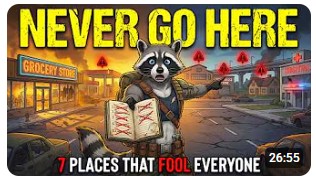
🦝 7 “Safe” Places That Turn Deadly Fast (and what to do instead)
When things go sideways, most people run to the same places… and that’s exactly why those places become danger zones within the first 72 hours.
Below is a detailed breakdown you can post (with icons), including the death trap, the why, and the overlooked alternative that gives you an edge.
🛒 1) Grocery Stores — “The Stampede Aisle”
Why your brain screams to go: food = survival wiring. It’s familiar. It feels close.
Why it becomes dangerous:
Panic buying turns shelves into chaos fast.
Narrow aisles + crowd pressure = people can’t move, can’t breathe, can’t exit.
Power outages break refrigeration quickly → spoiled food + sickness risk.
✅ Better alternative:
🕶️ Grey-man food sources: small ethnic markets, corner shops, independent butchers.
🧰 Build a 72-hour no-store kit: shelf-stable, no-cook items at home.
🤝 Local supply lines: farmers, CSAs, local producers (relationships beat crowds).
🏥 2) Hospitals — “The Building That Stops Being a Hospital”
Why people rush there: injury, sickness, medications, “professionals will help.”
Why it becomes dangerous:
Backup power and fuel are limited.
Overload happens fast → hallways packed, triage collapses, infections spread.
Staff often can’t stay (they have families too).
✅ Better alternative:
🩹 Build home medical capacity: first aid, wound care basics, basic training.
💊 Medication buffer: aim for practical refill planning where possible.
🧼 Hygiene and prevention: staying uninjured is the real “hospital plan.”
⛽ 3) Gas Stations — “Fuel You Can’t Access”
Why people rush there: “Fill up and escape.”
Why it becomes dangerous:
Pumps need electricity. No power = no fuel.
Lines become conflict zones. People get trapped in vehicles.
Stations are choke points with limited entrances/exits.
✅ Better alternative:
🚗 Half-tank rule: don’t let your vehicle drop below half.
🛢️ Small home rotation fuel plan: safe containers, rotate responsibly.
🚲 Backup mobility: bikes move when cars don’t.
🗺️ Paper map + back roads: plan routes that aren’t highways.
🏫 4) School Gyms / “Official Shelters” — The Waiting Room
Why people go: authority reflex. “There will be help there.”
Why it becomes dangerous:
Capacity is never enough → overcrowding destroys sanitation and safety.
Resources get divided into nothing (food, water, toilets, space).
Stress + strangers + scarcity = conflict grows fast.
✅ Better alternative:
🏠 Make home your 72-hour shelter: water, food, light, radio, first aid.
👥 Micro-community network: 3–5 trusted households with roles (med/logistics).
📍 Pre-scouted fallback location: only if leaving early is truly necessary.
🏬 5) Big Box Stores (Costco/Walmart/Home Depot) — “The Fortress Delusion”
Why people go: “Everything is there. The building is strong.”
Why it becomes dangerous:
Too many entrances → impossible to secure.
Huge, visible target → everyone knows what’s inside.
Leadership collapses inside → whoever is loudest/strongest takes over.
✅ Better alternative:
🕶️ Low-profile options: smaller, less obvious locations people overlook.
🪟 Reinforce home basics: doors/windows, light discipline, staying quiet.
🔇 OPSEC mindset: the best-prepared person is the one nobody suspects.
🛣️ 6) Highways / Overpasses / Bridges — “The World’s Longest Parking Lot”
Why people go: escape fantasy. “Just leave the city.”
Why it becomes dangerous:
Gridlock happens fast and turns cars into traps.
Bridges create hard choke points (one way in/out).
Fuel burns while idling → you end up stranded with everyone else.
✅ Better alternative:
⏱️ The timing rule: leave early (first hour) or wait until crowds thin.
🧭 Secondary routes: county roads, service roads, rail corridors (know them now).
🚲 Mobility over horsepower: bikes + feet beat SUVs in locked traffic.
🏠 7) “The Prepper Neighbor’s House” — The Most Personal Trap
Why people plan this: “They have a generator… supplies… they’ll take me in.”
Why it becomes dangerous:
Their plan was built for their household, not surprise guests.
More people = supplies collapse fast → tension and power struggles.
Anyone who “knows” becomes a knock at the door.
✅ Better alternative:
✅ Have your own 72-hour capacity (under your roof, your control).
🤫 OPSEC: don’t broadcast what you have.
🤝 Build real community on purpose: “If X happens, we meet here, bring this, do this.”
🛠️ Skills > stockpiles: skills make you an asset anywhere.
✅ Your 72-Hour Checklist (simple, real, doable)
Tonight, check just these basics:
💧 Water: ~1 gallon per person per day
🥫 Food: shelf-stable, minimal/no cooking needed
🔦 Light: flashlights, batteries, or hand-crank
📻 Comms: battery radio + charging plan
🩹 First aid: basic kit + any essential meds
🔇 OPSEC: keep it quiet, keep it normal
🦝 If this made you rethink your “go-to” plan, share it with someone you care about.
Because in the first 72 hours, the crowd doesn’t just move fast… it gets dangerous fast.
And the people who survive aren’t the ones with the best destination — they’re the ones who prepared before the panic.