
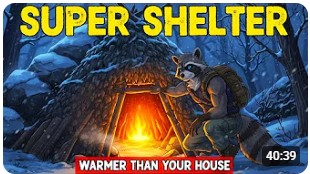
🦝 The Super Shelter Blueprint (21°F outside… 73°F inside)
No tent. No sleeping bag. No fancy gear. Just physics.
Tonight I’m building a shelter out of forest debris that outperforms home insulation — and I’m proving it with thermometers.
Because in a real grid-down situation, warmth is survival, but visible warmth is a target.
A big fire, bright light, and a smoke column isn’t “comfort”… it’s a dinner bell for every desperate person within miles.
This is about building a shelter that’s:
✅ warm
✅ efficient
✅ low-signature
✅ hard to detect
🌡️ THE CLAIM (and the proof)
21°F outside
73°F inside
No gear
Two thermometers (inside + outside)
Your body is a 100-watt heater.
Most people waste that heat.
This shelter traps it.
🧭 Part 1: Don’t Camp in the “Pretty Spot”
🧊 The Valley Trap (Frost Pocket)
Everyone wants the valley: flat ground, wind protection, water nearby.
It feels smart. It’s not.
Cold air is heavy. It flows downhill like water.
That “perfect meadow” becomes a lake of invisible cold overnight.
✅ Better move: Camp on the slope — not the top, not the bottom.
🍎 The Thermal Belt (the sweet spot)
About 1/3 up the hillside, cold air flows past you instead of pooling around you.
🪨 Part 2: Use the Forest’s Free Heater
🔥 Thermal Mass Advantage
A rock face isn’t just a wind block — it’s a heat battery.
Dense stone absorbs solar energy all day… then radiates it back at night.
✅ Best distance: about 3–5 feet (close enough for radiant heat, far enough to avoid conduction).
💧 Part 3: Drainage = Life
🌧️ “Dry Ground” Isn’t Always Dry
You’re not just picking a spot — you’re reading where water wants to go.
✅ Avoid:
darker soil pockets
greener channels
“nice depressions” (they become stream beds)
✅ Look for:
compact earth under a thin organic layer
slight slope that drains water away
👁️ Part 4: OPSEC (Operational Security)
In collapse conditions, geometry gives you away.
Straight lines. Clean angles. Smoke. Glint. Light.
Nature doesn’t make perfect triangles or neat ridgelines.
✅ Rule: Build ugly. Build irregular. Build invisible.
earth tones only
no shiny materials
camouflage = insulation + concealment
🏗️ Part 5: The Shelter Frame (Triangles Win)
🔺 A-Frame / Debris Hut = Survival Engineering
Triangles don’t rack. Squares collapse.
This is why the A-frame design keeps showing up across cultures.
✅ Key rule: Minimum volume.
If you can sit up inside it… it’s too big.
Every extra inch is air your body must heat.
🪵 Material Rule: Dead Standing vs Green Wood
🧱 Ridge Pole (Compression strength)
✅ Use dead standing hardwood (seasoned, strong, rigid)
doesn’t flex
holds load
won’t sag overnight
🦴 Ribs (flex + strength)
✅ Use wood that bends and springs back
not brittle dead wood
not floppy green wood
🍂 Part 6: Insulation Secret (Debris Isn’t the Insulator)
🌬️ Air is the Insulator
The leaves don’t keep you warm.
The dead air space trapped inside them does.
That’s how fiberglass works.
That’s how down works.
That’s how this works.
✅ Rule: Don’t compress the wall debris.
Loft = warmth.
✅ Wall thickness goal: armpit deep minimum.
🧊 The Ground Is the Real Killer
Heat loss into the ground (conduction) is savage.
Even if the air is survivable, the ground will drain you fast.
✅ Bed system (layered):
🪵 sticks/branches (foundation)
🌲 pine boughs (structure + cushion)
🍂 dry leaves (comfort layer)
Then: lay down, compress, add more until cold spots disappear.
🎯 Pressure points to protect: hips + shoulder blades.
🚪 Part 7: The Door Plug (the make-or-break move)
Your entrance is your biggest heat leak.
✅ Make it small: shoulder-width crawl hole
✅ Face it away from wind
✅ Seal it with a debris plug (thick like the walls)
Now you’re not “in a shelter”… you’re inside a closed thermal system.
🔥 Part 8: The Invisible Furnace (Heat Without the Target)
Fire is cheating — but it’s also a signal.
So we build a fire that’s:
✅ small
✅ hot
✅ low-smoke
✅ hard to see from the side
🪵 Rule 1: Dry fuel burns clean
Wet wood = smoke column = “human here”
✊ Rule 2: Small fires burn hotter
Hotter burn = less smoke (it consumes its own particulates)
🧱 Rule 3: Reflect heat, don’t waste it
Build a reflector wall to bounce infrared heat toward your shelter.
🧪 The Super Shelter Effect (Greenhouse Physics)
🧼 Clear plastic = thermal trap
Shortwave light goes in.
Longwave heat can’t escape easily.
Same reason your car gets scorching inside.
✅ Fire + reflector + plastic = warm bubble with low fuel and low signature.
📊 Part 9: The Thermometer Receipts
Start: 42°F inside / 42°F outside
Later: 58°F inside / 31°F outside
Later: 67°F inside / 24°F outside
Peak: 73°F inside / 21°F outside
That’s not “barely alive.”
That’s t-shirt comfortable.
🍽️ Part 10: The Calorie Math (Survival = Profit)
Building shelter: ~1,200 calories
Shivering: ~400 calories/hour
8 hours shivering: 3,200 calories (if you survive)
✅ Invest 1,200 to save 3,000+
That’s not survival… that’s smart economics.
✅ Key Takeaways (print this in your brain)
🧊 Avoid frost pockets (valleys and low spots)
🌡️ Camp in the thermal belt
🪨 Use thermal mass (rock face advantage)
🍂 Insulation = dead air space, not the leaves
🛏️ The ground will kill you faster than the air
🚪 Seal the entrance with a door plug
🔥 Heat is good — visible heat is dangerous
👁️ In collapse conditions: OPSEC matters
If you want real survival skill — not fantasy gear lists — learn the physics.
Because when the grid goes down, the people who win aren’t the loudest…
they’re the ones who stay warm without being seen.
Next up: 💧 Why stream water ruins you in 48 hours — and how to fix it.
Subscribe. Because in a collapse, thirst isn’t uncomfortable — it’s a countdown