
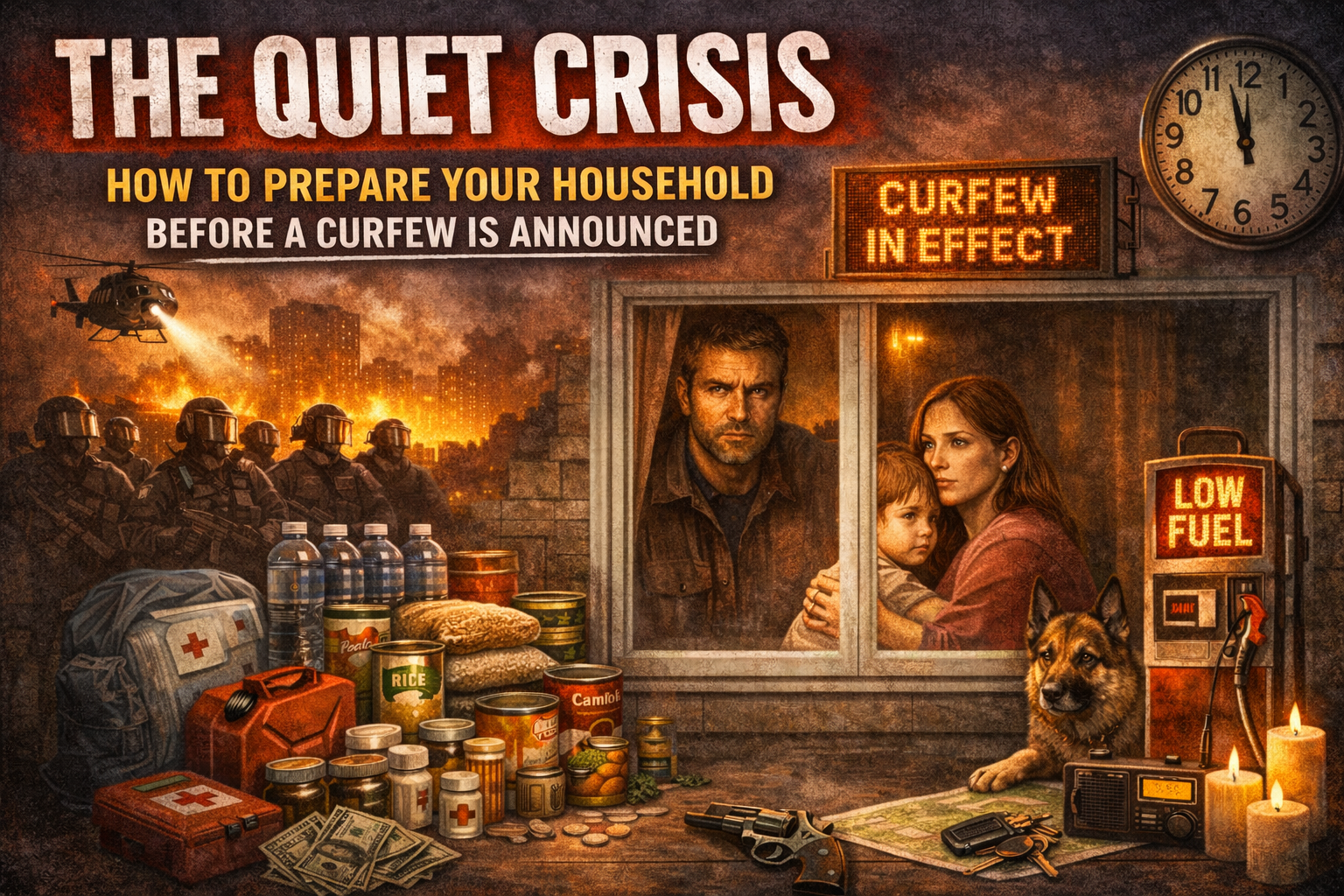
Curfews don’t start with chaos — they start with signals.
A shift in tone from officials.
Increased patrols.
Store hours changing “temporarily.”
Then suddenly — you’re on the clock.
Within hours:
- Shelves empty
Fuel lines form
Pharmacies close early
Movement becomes restricted
Most people react after the announcement.
Prepared households act before it ever happens.
Understanding the Real Risk
A curfew isn’t just about staying inside — it’s about losing access at the exact moment demand spikes.
The real threat isn’t the curfew itself.
It’s the compression of time and resources.
When everyone tries to get the same things at once:
- Supply chains choke
Stores reduce staff or close
Digital systems may slow or fail
Panic behavior spreads faster than information
Preparedness removes you from that equation entirely.
The 7-Day Self-Sufficiency Rule (Minimum Standard)
At a baseline, your household should be able to operate independently for at least 7 days without outside support.
This is not extreme prepping — this is modern resilience.
Water (Non-Negotiable)
Minimum: 1 gallon per person per day
Includes drinking + minimal hygiene
Store in multiple containers (not one large failure point)
Food (Practical, Not Fantasy)
Focus on:
Foods your family already eats
Minimal prep requirements
Long shelf life
Core categories:
Canned proteins (meat, beans)
Carbs (rice, pasta, oats)
Fats (peanut butter, oils)
Shelf-stable milk or alternatives
The goal: no stress, no sudden diet change, no waste
The Supply Chain Illusion (Why Most People Get Caught)
Modern systems rely on “just-in-time” delivery.
That means:
- Stores don’t hold large backstock
Deliveries are constant — until they stop
Disruption = empty shelves in hours, not days
During unrest or curfews:
- Delivery trucks may avoid areas
Staff shortages increase
Distribution centers prioritize other regions
You are not competing with your neighbors…
You are competing with a collapsing timing system
Medical Readiness: The Most Overlooked Weak Point
Most households prepare food and water —
but fail on health continuity.
During a curfew:
- Pharmacies shorten hours or close
Refills become difficult
Minor issues escalate fast
Your Medical Layer Should Include:
7–14 day buffer of prescriptions (minimum)
Pain relief (acetaminophen, ibuprofen)
Cold/flu meds
Anti-diarrheal (critical in food-related illness)
Electrolytes
Basic first aid kit
Hygiene supplies (soap, disinfectants)
Small medical gaps become big problems when access disappears.
Cash, Fuel, and Mobility (The Hidden Essentials)
Most people don’t think about this until it’s too late.
- Cash
ATMs can run out
Card systems can fail or be restricted
Small purchases become difficult
Keep:
- Small denominations
Enough for several days of essentials
Fuel
Gas stations may: Close early
Limit sales
Experience long lines
Rule: Never let your tank drop below half during instability.
Mobility = options
Options = resilience
Home Security During Curfew Conditions
Curfews change neighborhood behavior dramatically.
- Streets become quiet
Movement stands out
Opportunistic behavior can increase
Basic Security Layer:
Check all locks and entry points
Ensure exterior lighting works
Keep valuables out of sight
Use low-visibility lighting indoors during outages
You don’t need to look like a fortress
You need to look like not worth the risk
Family-Specific Preparedness (Where Most Plans Fail)
Generic plans break down quickly because real households aren’t generic.
- Children
Familiar foods (not survival rations)
Activities (books, games, puzzles)
Routine structure
Pets
Food (7+ days)
Water
Litter / waste management
Elderly / Medical Needs
Backup lighting
Mobility considerations
Medication redundancy
Preparedness is personal — not just logistical.
The Psychological Side of Curfew Survival
This is where many people struggle the most.
- Silence outside feels unnatural
News cycles amplify stress
Time perception changes
Control What You Can:
Limit news exposure (check, don’t binge)
Maintain routines: Meals
Sleep
Light activity
Keep structure in your day
Calm households make better decisions.
The Final Readiness Checklist
Before any announcement, you should already have:
Essentials
✔ 7-day food supply
✔ 7-day water supply
Medical
✔ Prescriptions buffered
✔ OTC meds + first aid
Security
✔ Locks + lighting checked
✔ Backup lighting available
Mobility
✔ Cash on hand
✔ Fuel above half tank
Household Needs
✔ Kids, pets, elderly accounted for
✔ Activities for downtime
The Real Goal: Stay Out of the Rush
When a curfew is announced:
Most people rush out.
Prepared people stay in.
That’s the difference.
Preparedness isn’t about fear —
it’s about removing yourself from chaos entirely.
Final Thought
A curfew doesn’t create problems —
it exposes who already had them.
Build quietly.
Prepare steadily.
Stay ahead of the timeline.
Because when the announcement comes…
your work should already be done.