
Most people don’t think about where their food actually comes from — until something disrupts the system.
What we’re seeing more and more is how fragile centralized food systems really are. Long supply chains, monocrops, and heavy chemical use create something that looks efficient… but breaks fast when pressure hits.
That’s where permaculture comes in — not just gardening, but a different way of thinking.
Instead of forcing the land, you work with it. You build systems that improve over time — better soil, better water retention, and more reliable food production.
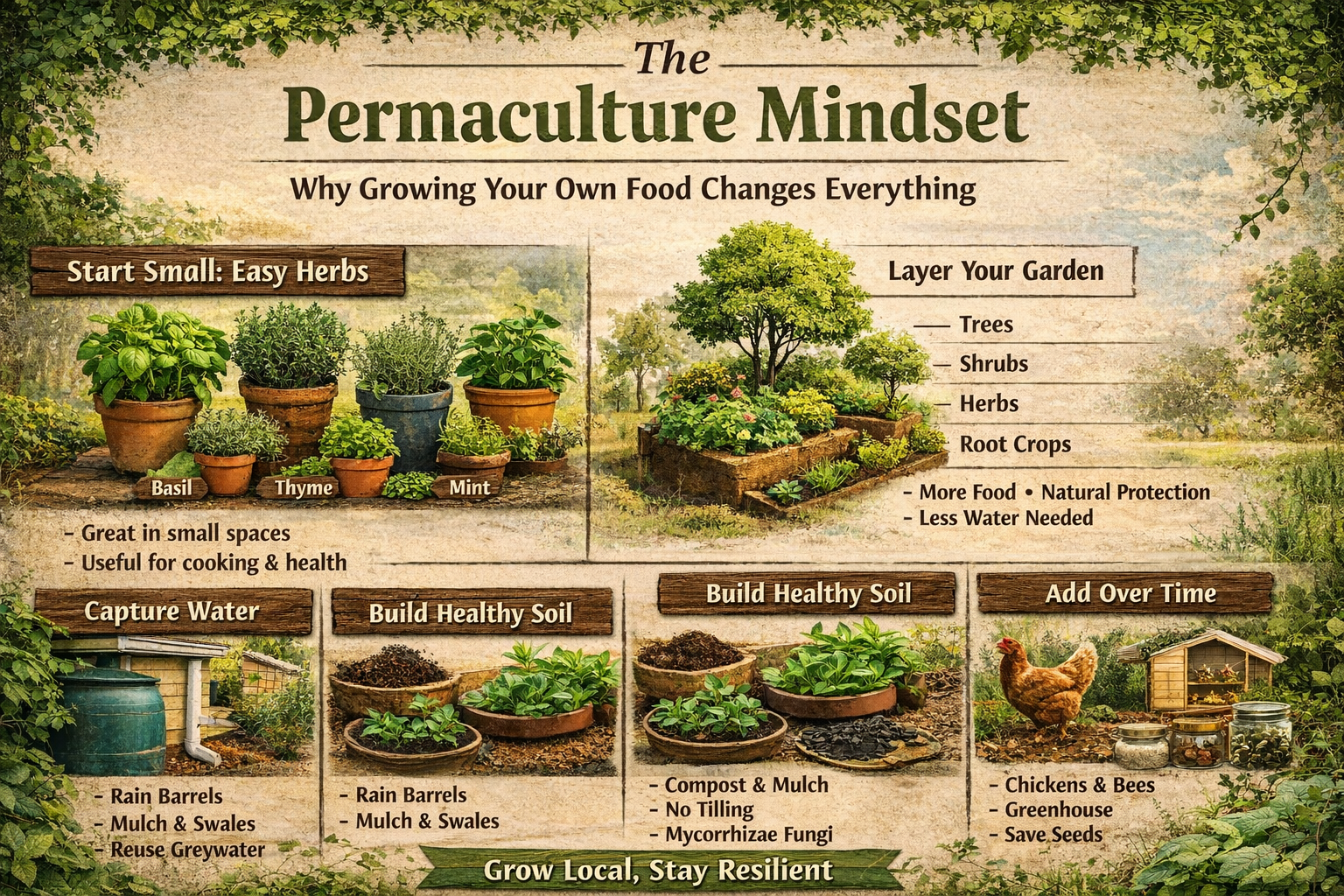
Start Simple: Herbs Anyone Can Grow
If you’re just getting into this, herbs are one of the easiest and most useful places to start:
Basil – fast growing, great for containers, good for meals and preservation
Mint – extremely hardy (almost too easy), good for teas and digestion
Thyme – drought tolerant, great for seasoning and medicinal use
Oregano – perennial, comes back every year, strong flavor and antimicrobial
Chives – low maintenance, regrow after cutting
Parsley – nutrient dense and easy to grow in small spaces
Sage – great for cooking and traditional remedies
Rosemary – hardy, long-lasting plant that can grow into a bush over time
These can all be grown:
In small backyard beds
On a balcony
Even inside near a window
Layering: Getting More From the Same Space
One of the core ideas is “stacking” your growing space.
Instead of one crop per area, you combine:
Taller plants (fruit trees or sunflowers)
Mid-level (shrubs like berries)
Ground cover (herbs like thyme or clover)
Root crops (carrots, garlic, onions)
This creates a system that:
Produces more food
Holds moisture better
Protects itself naturally
Water: Capture It or Chase It
Most people rely completely on tap water. In permaculture, you try to keep water on your land:
Rain barrels off your roof
Mulch to hold moisture in soil
Using kitchen greywater (where safe)
Planting drought-tolerant species
Water becomes something you manage — not something you depend on.
Soil: The Real Foundation
Healthy soil = everything.
Instead of buying fertilizers, you build your own system:
Compost food scraps
Add organic material (leaves, grass clippings)
Avoid over-tilling
Let natural biology do the work
Good soil holds water, grows stronger plants, and reduces the need for constant input.
Add Simple Systems Over Time
As you build out, you can add more layers:
Chickens for eggs + natural fertilizer
Bees for pollination + honey
Small greenhouses to extend seasons
Seed saving so you’re not buying every year
Why This Matters for Preppers
This isn’t about going off-grid overnight.
It’s about reducing dependence.
Even small steps:
Growing herbs
Adding a few vegetables
Learning composting
…start to shift you from consumer → producer.
That matters when:
Prices spike
Supply chains slow
Access becomes limited
Final Thought
You don’t need acres of land to start.
You need:
A small space
A few plants
And consistency
Because when systems around you get shaky…
the people who can produce even a little locally are the ones who stay ahead.