
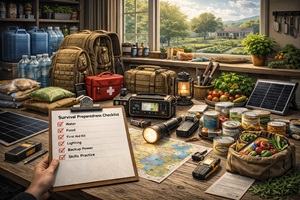
Category: Survival
Focus: Planning • Skills • Self Sufficiency • Crisis • Security
Objective: Build a complete survival system that works in real-world situations—not just theory or gear collecting
1. WHAT SURVIVAL REALLY MEANS
Survival is not:
- owning gear
- watching videos
- having a bug-out bag
Survival is:
- making correct decisions under pressure
- controlling your environment
- adapting faster than the situation changes
The biggest mistake people make is thinking survival is about stuff.
It’s about systems and mindset.
2. THE SURVIVAL HIERARCHY (REAL PRIORITIES)
When things go wrong, priorities are simple:
- Air
- Shelter
- Water
- Food
- Security
Most people prepare backwards.
Fix:
Build your system in this order – not randomly.
3. THE THREE SURVIVAL STRATEGIES
You must decide how you survive:
1. Bug In (Stay Put)
Best when:
- your home is secure
- you have supplies
- area is relatively stable
This is the primary strategy for most people
2. Bug Out (Leave)
Best when:
- your location becomes unsafe
- disaster is approaching
Requires planning, not panic
3. Hybrid Strategy
Stay until:
- a trigger point is hit
Then:
- leave early
Most realistic approach
4. BUILDING YOUR BASELINE (START HERE)
Before anything advanced, you need:
Minimum Setup:
- 3–7 days food
- water storage
- first aid kit
- lighting
- communication method
Why:
This covers most real disruptions
5. WATER PREP (MOST CRITICAL)
You can survive:
- weeks without food
- days without water
What You Need:
Storage:
- 1 gallon per person per day minimum
Backup:
- water filters
- purification tablets
- boiling method
Advanced:
- rain collection
- natural source mapping
Most people fail here first
6. FOOD PREP (BUILD IN LAYERS)
Layer 1:
- canned goods
- dry foods
Layer 2:
- bulk storage (rice, beans, oats)
Layer 3:
- long-term storage (freeze-dried)
Layer 4:
- food production (gardening)
Don’t just store food—learn to produce it
7. SHELTER AND ENVIRONMENT CONTROL
Your environment will kill you faster than anything else.
You Need:
- heat control (cold climates)
- cooling/shade (hot climates)
- dry shelter
Backup:
- alternative heating
- insulation
- emergency shelter
Comfort is survival
8. SECURITY (REALITY CHECK)
After disruptions:
- risk increases
- desperation increases
You Need:
- awareness first
- low profile
- layered defense
Key Rule:
Avoid problems before you try to solve them
9. COMMUNICATION (MOST OVERLOOKED)
Phones fail.
Backup:
- radios
- agreed meeting points
- offline plans
Information = survival advantage
10. MOBILITY (CRITICAL OPTION)
Even if you plan to stay:
You must be able to leave
You Need:
- vehicle ready
- fuel stored
- routes planned
Backup:
- bike
- foot plan
Mobility = freedom
11. MEDICAL PREP
Most people overlook this.
You Need:
- first aid kit
- medications
- basic knowledge
Advanced:
- wound care
- infection control
Injury becomes life-threatening fast
12. POWER AND ENERGY
Power loss = system failure
You Need:
- flashlights
- batteries
- backup power
Advanced:
- solar
- generator
Power = capability
13. SKILLS VS GEAR
Gear fails.
Skills don’t.
Learn:
- fire starting
- water purification
- repairs
- food prep
Skills reduce dependence
14. COMMUNITY VS LONE WOLF
Lone wolf sounds good—until reality hits.
Community provides:
- shared security
- shared knowledge
- shared resources
Trust matters
15. PRACTICE (WHERE MOST FAIL)
Plans don’t survive stress.
Test:
- no power for 24–72 hours
- live off supplies
- simulate evacuation
You will find your weaknesses
16. LONG-TERM SURVIVAL
Short-term is easy.
Long-term is where people fail.
You need:
- food production
- water sourcing
- repair skills
- trade ability
This is where real resilience exists
17. THE MINDSET THAT WINS
The people who make it:
- act early
- stay calm
- adapt fast
Not:
- the most gear
- the most money
18. FINAL TAKEAWAY
You don’t prepare for disasters.
You prepare for:
- disruption
- uncertainty
- loss of systems
If you:
- build layers
- reduce dependence
- increase skills
you move ahead of most people