
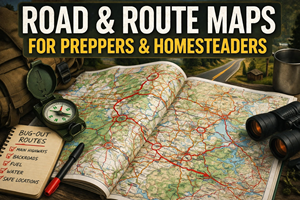
How people actually move — and where movement breaks down first
Road and route maps are not just about getting from Point A to Point B. For preparedness, they are about predicting human behavior, identifying chokepoints, and understanding which paths fail first under pressure.
If topographic maps show what the land allows, road maps show what people try to do — and that difference matters. In disruptions, people don’t suddenly become creative navigators. They follow habit, familiarity, and signage. That makes traffic patterns highly predictable, and predictability is something prepared people can work around.
For homesteaders, road maps are equally important. They define access to supplies, emergency services, markets, neighbors, and seasonal mobility. A homestead that is “peaceful” but functionally isolated can quickly become a liability if routes are fragile.
What a road & route map really is (beyond navigation)
At a basic level, road maps show:
- highways and interstates
- secondary and rural roads
- connectors between towns
- distances and general travel direction
But for preparedness, road maps function as stress maps. They show:
- where traffic concentrates
- where people funnel during evacuations
- where fuel demand spikes
- where accidents and closures have outsized impact
Every road network has weak points. Road maps help you find them before everyone else discovers them at the same time.
Why road maps matter for preparedness
1) Most people follow the same routes under stress
When things go wrong, people do not explore. They:
- take the biggest road
- follow official evacuation routes
- drive toward places they recognize
- avoid unfamiliar back roads
This creates instant congestion. Even a minor incident can turn a major highway into a parking lot.
Road maps allow you to see:
- which roads will attract the most traffic
- which towns act as funnels
- which routes have no meaningful alternates
Preparedness isn’t about being faster. It’s about not being stuck.
2) Fuel availability is tied to road structure
Fuel shortages don’t happen evenly. They appear first:
- along major corridors
- near highway exits
- in towns with high pass-through traffic
Road maps let you anticipate where fuel pressure will build and where quieter areas may retain access longer.
For preppers, this helps with:
- fuel staging
- timing decisions
- deciding when not to move
3) Road failures cascade quickly
A single closed bridge or interchange can:
- isolate entire communities
- force traffic into unsuitable roads
- overwhelm small towns
- block emergency access
Road maps help you identify:
- single-point failures
- “one way in, one way out” towns
- alternate crossing points
- roads that become impassable seasonally
Once traffic reroutes under stress, it’s already too late to improvise.
Why road maps matter for homesteaders
Homesteaders often focus on land, water, and soil — all critical — but access is just as important.
Road maps help homesteaders:
- plan reliable access year-round
- identify routes that wash out or ice over
- understand how deliveries and services reach them
- avoid properties dependent on fragile roads
A homestead that becomes unreachable during storms or supply disruptions may look romantic at first — until it creates repeated emergencies.
Road awareness helps you choose land that is resilient, not just remote.
Understanding road hierarchy (a simple but powerful concept)
Road networks are layered. Recognizing those layers helps predict behavior.
Primary roads (highways & interstates)
- carry the most traffic
- clog first
- attract fuel shortages
- are heavily policed and controlled
Secondary roads (state/provincial highways)
- become overflow routes
- clog later but stay busy longer
- often lack services
- see increased accidents under stress
Tertiary roads (county, rural, service roads)
- least obvious
- often overlooked
- may be seasonal or poorly maintained
- require local knowledge
Preparedness improves when you understand which layer you’re choosing — and why.
Chokepoints: the most important thing road maps reveal
A chokepoint is any place where movement must compress:
- bridges
- tunnels
- mountain passes
- ferry crossings
- river crossings
- limited-access interchanges
Road maps make chokepoints visible. Once you see them, you can’t unsee them.
Ask yourself:
- What happens if this bridge closes?
- Is there another crossing within 10 miles? 30 miles?
- How many communities depend on this route?
People often discover chokepoints only when traffic stops moving. Map readers see them in advance.
Evacuation routes: understand them, don’t blindly trust them
Official evacuation routes are designed for order, not flexibility. They assume:
- compliance
- fuel availability
- infrastructure integrity
- good weather
Road maps allow you to evaluate evacuation routes realistically:
- Where do they funnel?
- What happens if one segment fails?
- Where do they intersect with high population zones?
Knowing official routes lets you decide when to use them — and when to avoid them.
Real-world prepper use cases for road maps
Building a layered movement plan
A solid preparedness plan includes:
- a primary route (most efficient)
- a secondary route (less obvious)
- a tertiary route (last-resort, low traffic)
Road maps help you visualize and document all three.
Timing decisions
Sometimes the best move is not to move. Road maps help you judge:
- how fast congestion will form
- whether movement is still realistic
- when sheltering in place is safer
Preparedness is about timing as much as location.
Supporting bug-out logic
Bug-out decisions fail when people assume:
- roads will remain open
- traffic will flow
- fuel will be available
Road maps expose those assumptions before they become problems.
Where to get reliable road & route maps
United States
- USGS National Map Downloader (roads + base layers).
https://www.usgs.gov/tools/download-data-maps-national-map - OpenStreetMap exports (excellent for offline planning and custom map builds).
https://www.openstreetmap.org/export
Canada
- Statistics Canada spatial products (road networks + boundaries).
https://www12.statcan.gc.ca/census-recensement/2021/geo/sip-pis/index-eng.cfm - Provincial open data portals (many provinces provide detailed road layers).
(Tip: local or provincial open-data portals often provide better rural road detail than national summaries.)
Offline road-map strategy (don’t skip this)
Printed maps still matter
Keep:
- a regional road atlas
- printed maps of your immediate area
- printed maps of common travel corridors
Annotate them with:
- fuel stops
- seasonal closures
- bridge crossings
- alternate turn-offs
- notes like “avoid during storms”
Digital offline maps (test them)
Offline digital maps only count if:
- they’re downloaded in advance
- you test them with airplane mode
- you know how to switch views quickly
Printed maps are slower, but they never crash.
Simple practice drills (low effort, high payoff)
Drill A: “Find the funnel”
Pick a regional road map and identify:
- three chokepoints
- the communities affected if each fails
Do this once, and you’ll start noticing them everywhere.
Drill B: “Alternate thinking”
Choose a destination and plan:
- one route avoiding highways
- one route avoiding bridges
- one route avoiding towns
You don’t need to use them — you just need to know they exist.
Drill C: “Fuel logic”
Mark fuel stations along your routes and ask:
- What happens if these are closed?
- Where would demand spike first?
Common road-map mistakes
- Mistake: assuming back roads are always better
Fix: check maintenance, seasonal closures, and bridges. - Mistake: planning only one route
Fix: always have at least one fallback. - Mistake: ignoring population pressure
Fix: pair road maps with population density awareness. - Mistake: waiting until movement is urgent
Fix: route planning is a calm-time task.
How road maps connect to your site’s Prepper Map Packs
Your bug-out location maps and general prepper maps tell users where they might want to go. Road maps tell them whether they can realistically get there.
In the series, this pairing is key:
“A good location on paper is useless if the routes collapse.”
Road maps are the movement layer that turns your curated location maps into usable plans — instead of wishful thinking.