
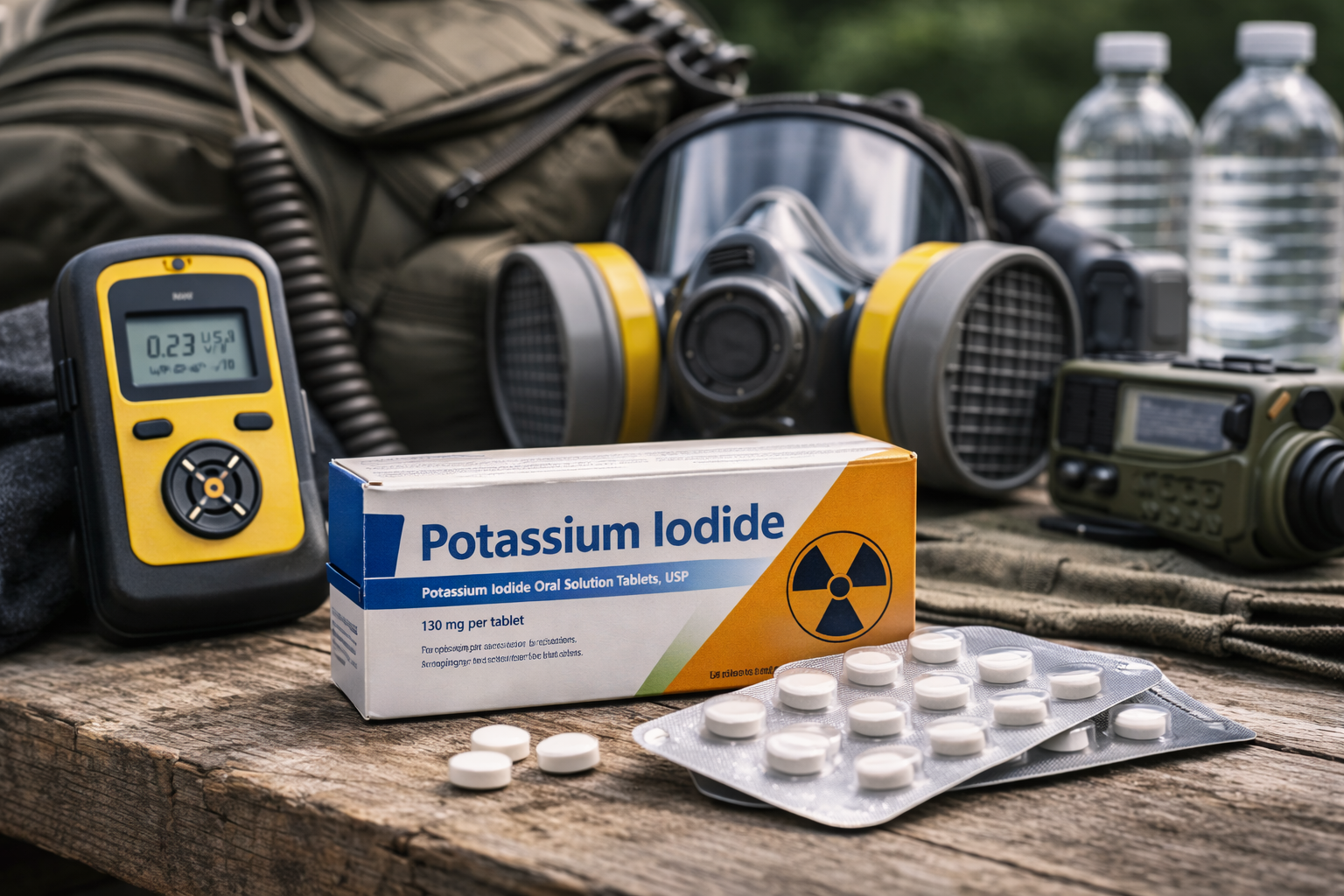
When people think about radiation emergencies, there’s often one item that comes up quickly: potassium iodide (KI). It’s frequently talked about as a must-have for nuclear scenarios—but it’s also one of the most misunderstood items in a preparedness kit.
This isn’t a magic pill. It’s a very specific tool with a very specific purpose. And understanding that difference matters.
What Potassium Iodide Actually Does
Potassium iodide is designed to protect one part of your body—the thyroid—from one specific threat: radioactive iodine.
In certain nuclear events, radioactive iodine can be released into the environment. If inhaled or ingested, it can accumulate in the thyroid, increasing the risk of long-term health issues.
KI works by saturating the thyroid with stable iodine. When the thyroid is already “full,” it is far less likely to absorb the radioactive version.
That’s it. That’s its job.
What It Does NOT Do
This is where many people get it wrong.
Potassium iodide:
Does not protect against all radiation
Does not shield other organs
Does not reverse damage after exposure
Does not replace evacuation, sheltering, or proper protective measures
It is not a general anti-radiation solution—it’s a narrow, targeted countermeasure.
Timing Is Everything
KI only works if taken at the right time.
For maximum effectiveness, it needs to be taken:
Shortly before exposure, or
Within a few hours after exposure begins
If taken too late, its protective effect drops significantly. It’s preventative, not a treatment.
Who It’s Meant For
Not everyone should take potassium iodide.
It’s generally prioritized for:
Infants and children
Pregnant or breastfeeding women
Adults under 40
These groups are more vulnerable to thyroid damage from radioactive iodine.
For older adults, especially over 40, the risks from KI itself can outweigh the benefits in many cases unless exposure levels are extremely high.
Risks and Considerations
Like any medical product, KI isn’t risk-free.
Potential issues include:
Allergic reactions
Digestive discomfort
Thyroid complications in certain individuals
It should only be used when directed by public health authorities during a confirmed radiation event involving radioactive iodine.
Stockpiling it without understanding when and how to use it can create a false sense of security—or worse, lead to misuse.
Where It Fits in a Real Plan
Potassium iodide is just one piece of a much bigger picture.
In a real-world scenario, your priorities should still be:
Sheltering effectively (distance and shielding matter most)
Avoiding contaminated air and food sources
Following official guidance
Managing water and food safety
KI doesn’t replace any of these. It complements them—under very specific conditions.
The Bottom Line
Potassium iodide is a powerful but limited tool. When used correctly, it can significantly reduce a very specific risk. When misunderstood, it can lead people to overlook more important protective actions.
Preparedness isn’t about having everything—it’s about knowing how and when to use what you have.
And in this case, knowledge matters just as much as the tablet itself.