
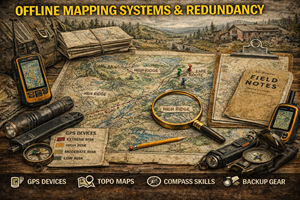
19. Offline Mapping Systems & Redundancy
Because a map that requires the internet isn’t a plan — it’s a gamble
Modern mapping is incredibly powerful. It’s also incredibly fragile.
Most people don’t realize how many things must work simultaneously for their digital maps to function: power, cell towers, servers, satellites, software updates, permissions, and batteries. When even one of those fails, the map disappears — often right when it’s needed most.
Offline mapping systems and redundancy exist to solve that problem. They ensure you can still orient, move, and decide when technology degrades or fails completely.
For preppers and homesteaders, offline mapping is not old-fashioned — it’s foundational.
What offline mapping & redundancy actually mean
Offline mapping is not just “downloading a map to your phone.”
True redundancy means:
- multiple map formats
- multiple access methods
- multiple storage locations
- multiple skill sets
It assumes that something will fail — and plans accordingly.
Preparedness improves when no single failure removes your ability to navigate or understand your environment.
Why offline mapping matters for preparedness
1) Digital convenience hides fragility
Modern mapping depends on:
- live data connections
- proprietary apps
- device-specific updates
When networks congest or fail:
- maps may not load
- GPS may be inaccurate
- apps may refuse to open
Offline systems remove those dependencies.
2) Stress amplifies technical failure
Under stress:
- batteries drain faster
- devices get dropped or lost
- simple mistakes become costly
Paper maps don’t crash, freeze, or lock you out.
Prepared people plan for human error, not just system failure.
3) Redundancy buys time
Offline maps allow you to:
- pause and reassess
- choose alternate routes
- avoid panic-driven decisions
Time is often the most valuable resource in a disruption.
Core layers of an offline mapping system
1) Paper maps (non-negotiable)
At minimum:
- regional road map
- topographic map of your area
- hazard-specific overlays
Paper maps:
- work without power
- can be annotated
- are shareable instantly
They are the backbone of redundancy.
2) Printed custom map sets
Prepared people often print:
- bug-out routes
- survivability regions
- hazard avoidance zones
Laminated or stored in waterproof sleeves, these maps become field tools — not reference material.
3) Offline digital maps (secondary layer)
Offline-capable apps and devices can still be useful if:
- maps are pre-downloaded
- devices are charged
- you understand their limitations
They should support paper maps, not replace them.
4) Knowledge redundancy
Knowing how to:
- read contour lines
- estimate distance
- orient with terrain
- navigate without GPS
…is just as important as having maps.
Maps are tools. Skills are backups.
Why redundancy matters for homesteaders
Homesteaders may face:
- long power outages
- seasonal access changes
- isolation during storms
Offline maps help homesteaders:
- plan supply runs
- manage access routes
- assist neighbors
- coordinate response
A homestead with redundant mapping is more autonomous, not just more prepared.
Common offline mapping failures (and how to avoid them)
Failure: relying on one device
Fix: store maps in multiple formats and locations.
Failure: outdated maps
Fix: review and update annually or after major changes.
Failure: unreadable maps
Fix: practice reading them before you need to.
Failure: maps without context
Fix: annotate with local knowledge.
Building a simple, effective offline mapping kit
A practical kit might include:
- regional road atlas
- topographic maps of local area
- printed hazard maps
- handwritten notes
- pencils and markers
- compass
Stored in:
- a home binder
- a vehicle kit
- a go-bag
Redundancy means not all in one place.
Practice drills for offline mapping
Drill A: “Phone off”
Navigate to a familiar location using only paper maps.
Drill B: “Route loss”
Assume a primary route is unavailable. Find an alternate on paper.
Drill C: “Group navigation”
Explain a route to someone else using a map. Clarity matters.
Ethical and security considerations
Offline maps should:
- avoid exposing sensitive locations unnecessarily
- be shared thoughtfully
- balance preparedness with discretion
Preparedness includes information stewardship, not just collection.
How offline mapping fits your Prepper Map ecosystem
Your curated map content becomes exponentially more valuable when users:
- print it
- annotate it
- integrate it into personal systems
Offline mapping turns your platform from an information source into a real-world preparedness tool.
This reinforces your philosophy:
“Preparedness works when it still works without the internet.”