
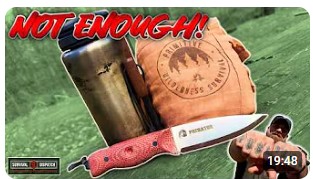

Minimal survival kits have become a popular topic lately. The concept sounds great on paper — carry only the essentials, rely on skill instead of equipment, and prove you can manage in the wild with very little. But the real question is whether these stripped-down kits are actually enough if something goes wrong.
In this video I take a closer look at the idea of minimal kits and explain why they can be valuable for training, but risky if people start thinking they are all they need in a true emergency.
I recently watched a video from Phillip Liebel at Primitive Wilderness Survival where he demonstrated the small kit he carries in the field. It was a good reminder of how much can be done with very little gear. After watching it, I decided to pick up a few items from his site and build a kit around them so I could explore the concept myself.
In the video I walk through several pieces of gear, including the PWS multipurpose cloth, the hand drill fire kit, a single-wall stainless bottle, an antler-handled ferro rod, and the Primal Blade. I also compare them with the tools I already carry, like my usual knife, fire starters, and water container.
Phillip approaches survival from a primitive living skills perspective, focusing heavily on working with natural materials and traditional techniques. My own background is a bit different since I spent years involved in rescue operations, where the focus is helping people survive real situations as efficiently as possible.
Even with those different perspectives, something interesting stands out: the priorities are almost identical.
One of the biggest lessons in survival is that equipment multiplies your capability. Many of the tools people carry are items that would be extremely difficult to recreate in the wild. A reliable knife, a metal container for boiling water, or dependable fire-starting tools can save huge amounts of energy and time.
Minimal kits are great for building skills and confidence. Limiting yourself forces you to think creatively and sharpen your understanding of the fundamentals like fire, shelter, and water.
But real emergencies rarely happen under ideal conditions.
You might be tired, injured, cold, dehydrated, or dealing with bad weather. In those situations, relying only on the bare minimum can make things much harder than they need to be.
From a rescue perspective, one pattern shows up again and again: most people who end up in serious trouble simply weren’t prepared enough. Often it isn’t just gear they lacked, but also the mindset and experience to manage the situation.
Another thing to remember is that even the people who teach primitive survival skills rarely rely on minimal kits in everyday situations. Many of them train with small kits as a way to challenge themselves and maintain their abilities, but they still carry additional gear when it actually matters.
Training with minimal equipment can teach valuable lessons about priorities and decision making. It can also highlight just how important certain tools really are.
In the end, survival always comes back to a few key needs: shelter, water, fire, food, safety, and the ability to signal for help.
Practicing with less gear can improve your skills. But when the situation is real and the stakes are high, having the right tools on hand can make a huge difference.
Minimal kits are a great way to learn.
They just shouldn’t be mistaken for a complete survival plan.