
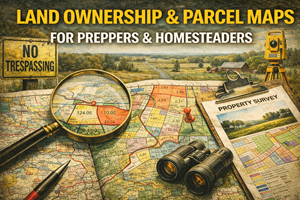
Knowing where you can go, where you shouldn’t, and why legal clarity becomes survival clarity
Land ownership and parcel maps are some of the least discussed — and most misunderstood — maps in preparedness. Yet in real-world disruptions, confusion over land access causes more conflict, hesitation, and bad decisions than almost any other factor.
When stress is high, people make assumptions:
- “This looks like public land.”
- “No one will care right now.”
- “We can cut through here just this once.”
- “It’s probably fine.”
Those assumptions are exactly what get people stopped, confronted, detained, or worse.
For preppers and homesteaders, parcel maps are not about bureaucracy. They are about knowing your options without guessing, and moving with confidence instead of hesitation.
What land ownership & parcel maps actually show
Parcel maps display who owns what, and often include:
- property boundaries
- parcel sizes
- public vs private land
- easements and rights-of-way
- access roads and legal entry points
- sometimes zoning or land-use classifications
These maps are typically maintained by counties, municipalities, provinces, or regional land registries. They represent legal reality, not convenience.
In preparedness terms, parcel maps answer questions like:
- “Is this land public, private, or mixed?”
- “Is this road actually legal to use?”
- “Is there a right-of-way here, or is this trespass?”
- “Where does public land actually begin and end?”
These answers matter far more when systems are strained.
Why land ownership maps matter for preparedness
1) Legal clarity reduces hesitation under stress
In high-pressure situations, uncertainty slows people down. When you don’t know whether you’re allowed to cross a piece of land, your brain stalls:
- Do we stop or keep moving?
- Do we backtrack?
- Do we risk confrontation?
Preparedness isn’t about bravado — it’s about smooth, confident decision-making. Parcel maps remove ambiguity so you don’t waste time second-guessing yourself.
2) Conflict risk increases during disruptions
As conditions deteriorate, people become more protective of what they control — land included. Trespassing that might be ignored during normal times can escalate quickly when:
- resources are scarce
- people feel threatened
- law enforcement response is uneven
- communication is poor
Parcel maps help you avoid unnecessary conflict by keeping you on legally defensible ground whenever possible.
3) Public land is often misunderstood
Many people assume:
- “Forest = public”
- “Empty land = unowned”
- “No fence = no problem”
None of that is reliable.
Parcel maps clearly show:
- national, provincial, and state lands
- county or municipal lands
- conservation areas with access rules
- privately owned land that looks public
Knowing the difference is critical for ethical movement, foraging, hunting, and shelter planning.
Why land ownership maps matter even more for homesteaders
Homesteaders operate within land systems every day. Parcel maps support:
- long-term neighbor relations
- understanding easements and access rights
- planning driveways and utility runs
- identifying shared access roads
- avoiding landlocked parcels
Many rural disputes come down to misunderstandings about boundaries or access. Parcel maps prevent years of tension by clarifying expectations early.
They also help homesteaders think ahead:
- What happens if a neighbor sells?
- Who controls the access road?
- What land around us is public vs private?
- Where could pressure increase if population shifts?
Preparedness for homesteaders is as much about social geography as physical geography.
Easements: the hidden layer most people miss
Easements are legal rights to use part of someone else’s land for a specific purpose. Common examples include:
- utility easements
- shared driveways
- access corridors to landlocked parcels
- rights-of-way across private land
Parcel maps often show these — but many people never learn to look for them.
In preparedness contexts, easements can:
- provide legal access routes others overlook
- explain why certain roads exist
- reveal why some land can’t be built on
- clarify who has rights during disputes
Ignoring easements can lead to assumptions that later cause problems.
Land ownership maps and ethical preparedness
Ethical preparedness matters — not just morally, but practically.
People who consistently respect boundaries:
- face fewer confrontations
- maintain better community standing
- have more allies during disruptions
- avoid escalation
Parcel maps help you:
- forage responsibly
- hunt legally
- travel without provoking hostility
- choose shelter or staging areas appropriately
Preparedness that ignores legality often collapses under social pressure long before resources run out.
Real-world prepper use cases for parcel maps
Planning routes that stay “clean”
When planning bug-out or fallback routes, parcel maps help you:
- avoid cutting across private land
- identify public corridors
- plan legal alternates if roads are blocked
This matters when enforcement is inconsistent and misunderstandings escalate quickly.
Choosing realistic survive-off-the-land areas
Many “great-looking” survival areas fail a simple test: they’re almost entirely private.
Parcel maps help validate whether:
- public land is accessible
- land-use rules allow camping or foraging
- access points actually exist
Your site’s curated “survive off the land” maps become far more valuable when users understand this layer.
Avoiding landlocked traps
Parcel maps reveal landlocked parcels and regions where:
- access depends on one road
- access depends on one neighbor
- easements are fragile or disputed
In disruptions, those are places people get stuck.
Where to find land ownership & parcel maps (real sources)
United States
- County GIS & Assessor Portals
Most U.S. counties maintain parcel viewers. Search:
“ parcel map” or “ GIS”
These often include:
-
- ownership boundaries
- parcel IDs
- easements
- road access layers
- Bureau of Land Management (BLM)
Useful for identifying federal public lands in many western states.
https://www.blm.gov/services/geospatial/GISData
Canada
- Provincial land registry and parcel systems
Each province maintains its own system (e.g., LTSA in BC, OnLand in Ontario).
These show parcel boundaries and ownership information. - Crown land use maps
Crown land access varies by province and purpose. Provincial portals typically provide interactive maps showing public land status.
(Tip: parcel maps are almost always more accurate at the local/provincial level than national summaries.)
Offline strategy for parcel maps
Parcel data is harder to keep fully offline, but you can still prepare.
Build a “boundary awareness packet”
Include:
- printed screenshots of key parcel boundaries
- maps showing public vs private land near routes
- notes on known easements or access corridors
- written summaries of local land-use rules
This doesn’t need to be perfect — it just needs to prevent obvious mistakes.
Practice drills that actually matter
Drill A: “Public or private?”
Pick three nearby areas you assume are public. Verify with parcel maps. Most people are surprised at least once.
Drill B: “Route legality check”
Take one of your planned routes and verify:
- every road segment
- every shortcut
- every crossing
Mark any questionable areas and plan alternates.
Drill C: “Access point identification”
Find where public land is legally accessed — not just where it looks accessible.
Common mistakes with land ownership maps
- Mistake: assuming rural land is public
Fix: verify with parcel data before relying on it. - Mistake: ignoring easements
Fix: look for rights-of-way and shared access indicators. - Mistake: thinking “rules won’t matter in an emergency”
Fix: remember that confusion + stress increases conflict, not forgiveness. - Mistake: failing to plan legal alternates
Fix: always have at least one route that stays clearly lawful.
How land ownership maps connect to your Prepper Map Packs
Your curated maps — especially:
- best places to survive off the land
- best foraging areas
- best bug-out locations
…become actionable when users understand land ownership context.
This is the key message in the series:
“Preparedness isn’t just knowing where resources exist — it’s knowing where you can legally and safely access them.”
Parcel maps turn good ideas into usable plans.