
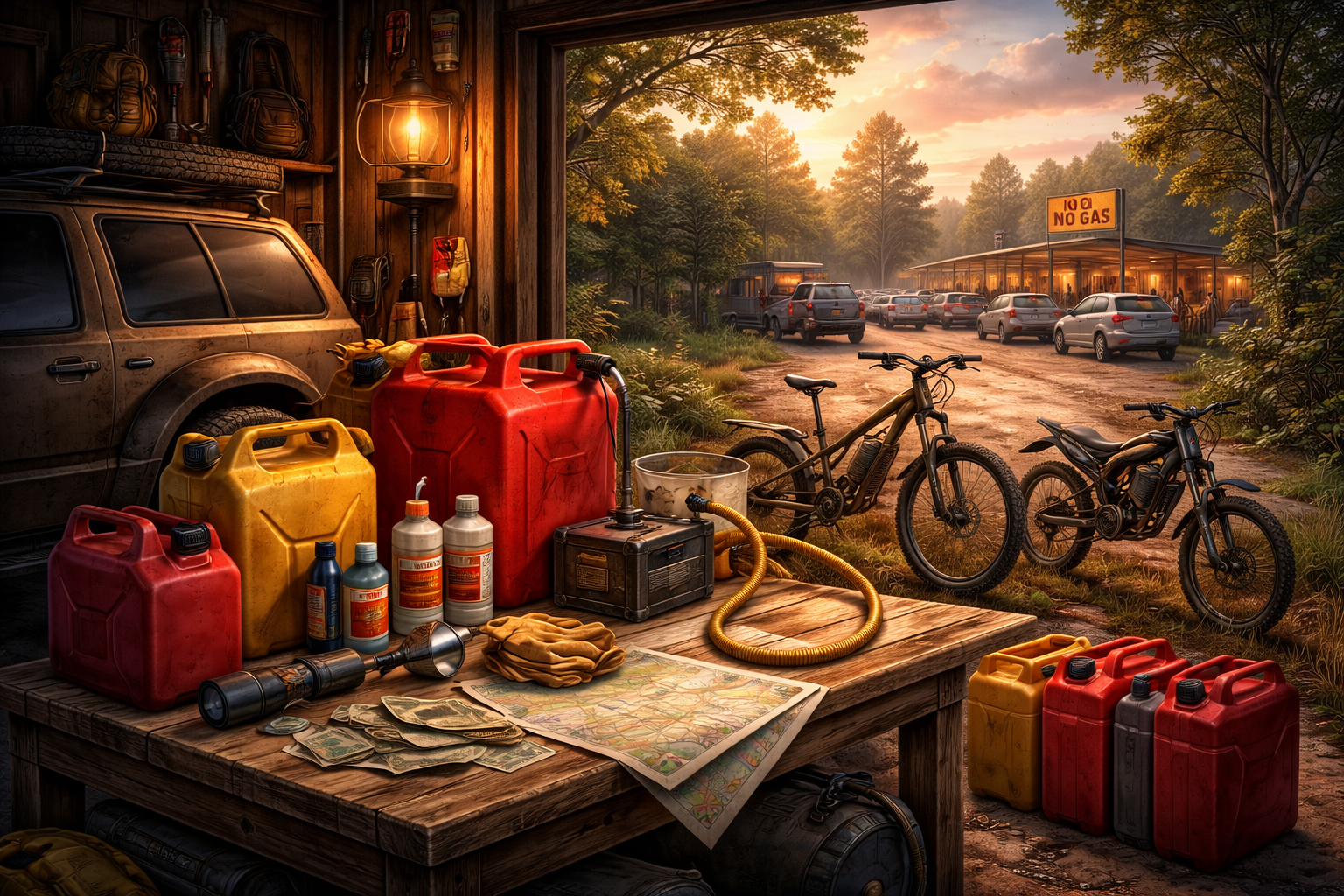
Fuel Rationing: How Preppers Stay Mobile When Everyone Else Is Stuck
Fuel isn’t just convenience.
It’s freedom of movement.
And when fuel becomes limited – whether from disruption, policy, or panic buying – that freedom disappears faster than most people expect.
Not in weeks.
Not in days.
Sometimes in hours.
Most people prepare for food shortages.
Some prepare for power outages.
Very few prepare for what happens when:
You simply can’t go anywhere anymore.
The Reality: Fuel Systems Are Built for Normal – Not Stress
Modern fuel systems are incredibly efficient…
but also extremely fragile.
Gas stations:
- Typically hold only a few days of supply
Depend on constant deliveries
Cannot handle sudden spikes in demand
Disruptions can come from:
- Cyber attacks
Pipeline shutdowns
Natural disasters
Panic buying
Government restrictions
The system works perfectly… until it doesn’t.
And when it fails:
- Stations run dry the same day
Lines stretch for hours
Priority shifts to emergency services
The Shift: Fuel Becomes a Controlled Resource
In a rationing scenario, fuel stops being “available” and becomes:
Allocated
This can look like:
Purchase limits (e.g., $20 max per visit)
Odd/even license plate systems
Digital tracking tied to ID or accounts
Priority access for certain roles
At that point, driving is no longer routine –
it becomes strategic.
Step 1: Audit Your Current Fuel Reality
Most people underestimate how much they actually drive.
Start here:
Track for 7 days:
Every trip
Distance
Purpose
Then categorize:
Essential (work, medical, supply runs)
Optional (convenience trips, habits, duplicates)
This alone often cuts fuel use by 20–40% immediately
Step 2: The “Trip Stacking” Strategy (Upgrade to the 3-Trip Rule)
Instead of reacting to errands — you engineer movement.
The Rule:
Every time you leave your home, you complete multiple objectives.
Example:
Grocery store
Pharmacy
Hardware store
Fuel stop
→ One loop instead of four trips
Advanced Layer:
Pre-plan routes to avoid backtracking
Hit high-priority stops first (in case supplies are gone)
Travel during low-traffic windows
You’re not just saving fuel — you’re reducing exposure and risk
Step 3: Build a Fuel Buffer (Without Being Reckless)
A small fuel reserve changes everything.
Practical Range:
20–60 gallons per household
This gives you:
- Emergency mobility
Evacuation capability
Generator support
Flexibility during shortages
Critical Rules:
Use certified containers only
Store in cool, ventilated areas (not inside living space)
Treat with fuel stabilizer
Rotate every few months
Stored fuel is not about hoarding — it’s about time advantage
Step 4: Know Your Numbers (Most People Don’t)
You need to know:
- Your vehicle MPG
Weekly fuel usage
Range per tank
Example:
25 MPG vehicle
200 miles/week
→ 8 gallons/week
Now ask:
How long do I want mobility?
What is “essential travel only”?
Planning without numbers = guessing under pressure
Step 5: Layered Mobility (This Is Where Preppers Win)
The biggest mistake people make:
They rely on one system
Real preparedness = layers
Layer 1: Primary Vehicle
Truck / SUV / main car
Used for long distance, hauling, evacuation
Layer 2: Efficiency Vehicle
Compact car / diesel / motorcycle
Used for daily essential travel
Layer 3: Fuel-Free Mobility
Bicycle
E-bike
Walking routes
Carts / trailers
When fuel disappears…
this layer becomes your lifeline
Step 6: The Half-Tank Rule (Non-Negotiable)
If there is even a hint of instability:
Never let your vehicle drop below half a tank
Why this matters:
Gas stations may not be available later
Lines waste fuel while idling
You may need to leave immediately
This is one of the simplest habits —
and one of the most powerful.
Step 7: Evacuation Fuel Strategy (Where Most Fail)
During evacuations:
- Highways gridlock
Fuel stations empty first
Vehicles burn fuel sitting still
Advanced Prep:
Pre-map secondary routes
Avoid major evacuation corridors
Store enough fuel to skip first 1–2 stops
Keep: Fuel containers
Transfer pump
Backup route plans
Mobility isn’t just about fuel — it’s about movement under pressure
Step 8: Fuel Efficiency = Force Multiplier
Small habits = big impact over time
- Increase Range Without More Fuel:
Maintain proper tire pressure
Avoid aggressive acceleration
Reduce idle time
Drive slightly slower on highways
These can improve fuel economy by:
10–25%+ over time
Step 9: Think Beyond Fuel (This Is the Real Shift)
Fuel preparedness is not about gasoline.
It’s about:
- Maintaining income
Reaching supplies
Checking on family
Evacuating safely
Staying independent
When others are stuck…
You still have options
Final Mindset: Mobility = Survival Advantage
Most people won’t think about fuel until:
- The lines start
The pumps go dry
The restrictions begin
By then — it’s too late.
Prepared households:
- Drive less before they have to
Store fuel safely
Plan routes in advance
Build alternative mobility
Final Thought
When fuel becomes scarce…
The question isn’t:
“How much do you have?”
It’s:
“How long can you stay mobile when others can’t?”
Because in any real disruption…
Mobility isn’t convenience.
It’s control.