
Surviving the initial collapse is only the beginning.
The real challenge isn’t making it through the first few days… it’s what comes after.
When systems fail—food supply, healthcare, power, communication—the people who make it long-term aren’t just survivors… they’re builders.
This is about rebuilding stability, security, and a future—not just getting by.
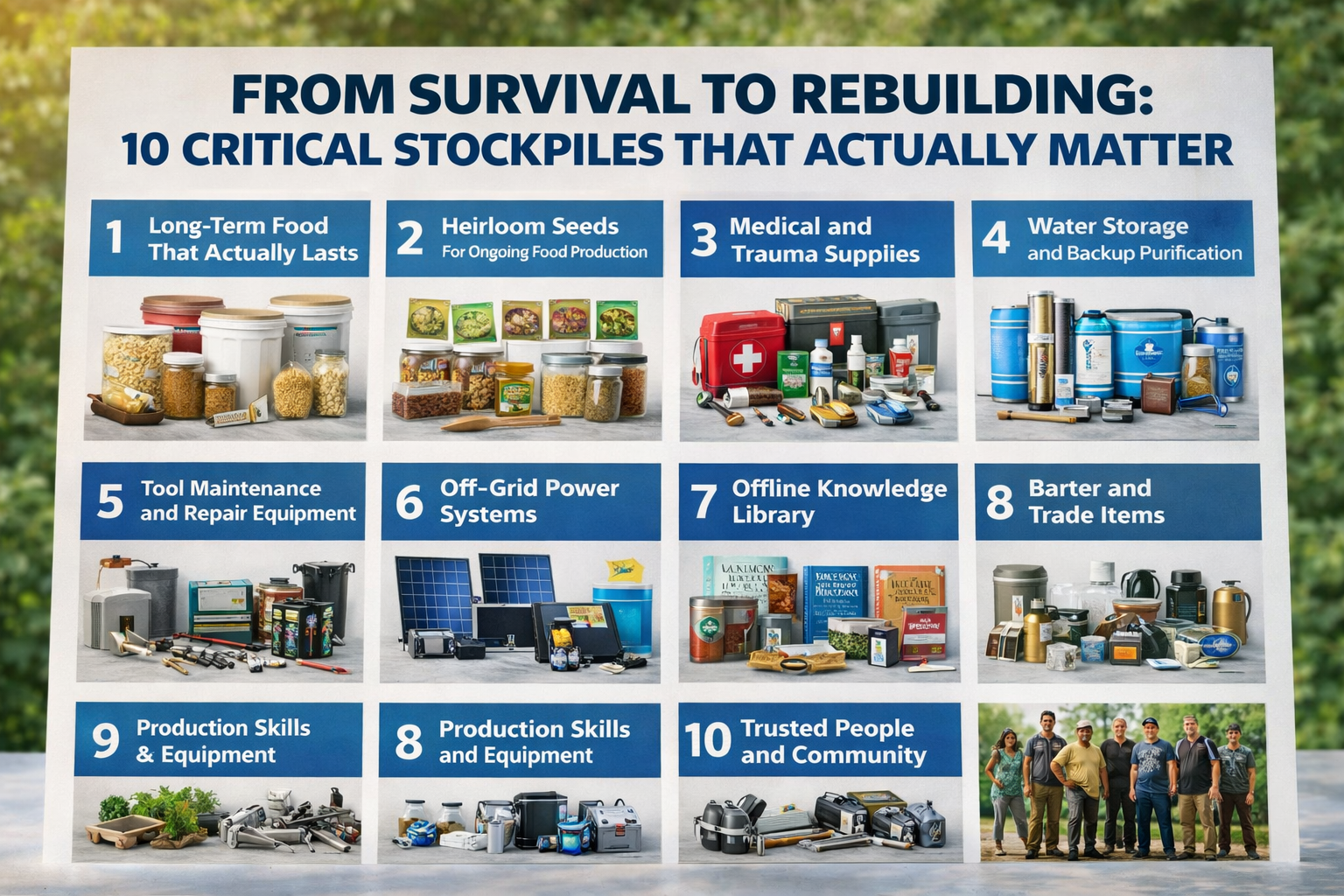
Below is a practical breakdown of the 10 most important stockpiles that move you beyond basic prepping into long-term resilience.
1. Long-Term Food That Actually Lasts
You need more than convenience food—you need calorie security.
Focus on bulk staples like rice, beans, wheat, and oats. These foods store well for years when packaged properly and provide the calories your body needs to function.
Salt, sugar, and honey are also critical—not just for nutrition, but for preservation and trade.
The goal isn’t variety at first. The goal is making sure you don’t run out of calories.
2. Heirloom Seeds for Ongoing Food Production
Stored food is temporary. The ability to grow food is permanent.
Heirloom seeds allow you to plant, harvest, and then replant using seeds from your own crops. This creates a sustainable cycle.
Focus on calorie-dense crops like potatoes, beans, squash, and corn. Learn how to store seeds properly and test their viability over time.
This is the shift from surviving to sustaining.
3. Medical and Trauma Supplies
Without access to modern healthcare, small injuries can become life-threatening quickly.
You need more than a basic first aid kit. Focus on wound care, bleeding control, infection prevention, and basic medications.
Just as important as the supplies is the knowledge. Learn how to use everything before you need it.
4. Water Storage and Backup Purification
Water is one of the fastest ways things go wrong.
Stored water is your first line of defense, but it’s not enough on its own. You need multiple ways to make water safe:
Filtration for bacteria and parasites
Chemical treatment for viruses
Boiling as a reliable backup
Redundancy is critical. If one method fails, you need another ready.
5. Tool Maintenance and Repair Equipment
Every tool you own will eventually wear out or break.
Sharpening stones, files, repair kits, and spare parts allow you to extend the life of your tools and keep systems running.
Without maintenance capability, your gear slowly becomes useless.
6. Off-Grid Power Systems
Power provides more than comfort—it supports communication, lighting, and small critical systems.
Solar is one of the most practical long-term options. Even a small setup can keep essential devices running.
Focus on efficiency and necessity rather than trying to power everything.
7. Offline Knowledge Library
When the internet is gone, what you know—and what you have written down—is all that remains.
Build a collection of printed materials covering:
Medical care
Food production
Repairs and basic engineering
Survival skills
Knowledge allows you to solve problems, adapt, and teach others.
8. Barter and Trade Items
If traditional currency loses value, trade becomes essential.
Items that are useful, consumable, or hard to replace become valuable quickly. This can include food, supplies, tools, and everyday necessities.
Think in terms of real-world usefulness, not money.
9. Production Skills and Equipment
Supplies run out. Skills don’t.
The ability to grow food, repair equipment, purify water, and preserve resources becomes more valuable over time.
Tools support skills—but skills are what keep everything going.
10. Trusted People and Community
This is the most important and most overlooked factor.
No one can do everything alone. A group with diverse skills—medical, mechanical, agricultural, and organizational—is far more resilient than any individual.
Trust, cooperation, and shared effort are what rebuild stability.
Final Thought
Most people prepare for the event.
Very few prepare for what comes after.
The goal isn’t just to survive a crisis—it’s to build something that lasts beyond it.
Shift your mindset:
From stockpiling to systems
From short-term survival to long-term resilience
From going alone to building community
That’s what makes the difference.