
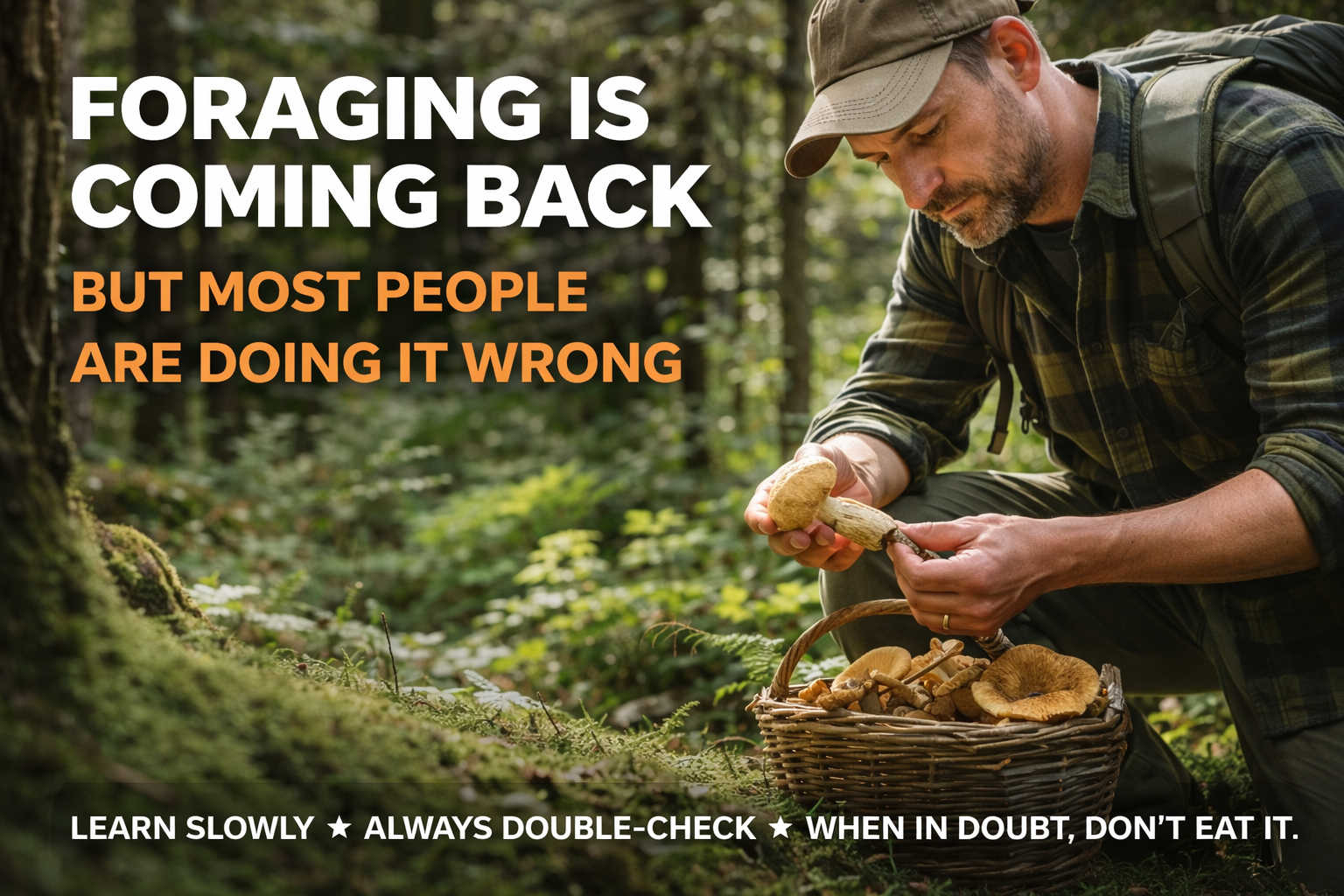
Why This Skill Matters More Than Ever for Real Preparedness
Across North America and beyond, more people are heading into the woods, fields, and even urban green spaces looking for food.
Not because it’s trendy.
Because something deeper is shifting.
People want:
More control over their food
Less reliance on fragile supply chains
Real-world skills that actually matter
Foraging is becoming one of those skills again.
But there’s a problem…
The Truth Most Beginners Don’t Hear
Foraging isn’t just “finding free food.”
It’s a skill that:
Requires patience
Demands accuracy
Punishes mistakes
You don’t get a second chance if you misidentify something.
And that’s where most people go wrong.
They jump in too fast.
Why Foraging Is Growing Right Now
There are a few clear reasons this is happening:
1. Food Awareness Is Changing
People are starting to question where their food comes from—and how reliable it really is.
2. Rising Costs
Food prices keep climbing, and people are looking for ways to supplement what they have.
3. Skill-Based Living
There’s a growing shift toward:
Self-reliance
Homesteading
Practical, hands-on knowledge
Foraging fits right into that.
What Foraging Really Teaches You
This isn’t just about food.
It builds:
Awareness of your environment
Seasonal understanding
Pattern recognition
Confidence in your ability to provide
Over time, you stop seeing land as “just land”…
and start seeing it as a resource.
The Right Way to Start (Most Important Section)
If you’re serious about this skill, keep it simple:
Start Small
Pick 1–2 plants that are:
Easy to identify
Common in your area
Hard to confuse with toxic lookalikes
Learn them completely before moving on.
Use Multiple Sources
Never rely on just one:
Field guide
Website
Video
Cross-check everything.
Learn Your Local Area
What grows in:
Forests
Riverbanks
Fields
Even urban areas
Every region is different.
Respect the Environment
Avoid harvesting from:
Roadside areas
Industrial zones
Sprayed land
Contamination is a real risk.
The Biggest Danger: Misidentification
This is where things get serious.
Some edible plants have toxic lookalikes that:
Look almost identical
Grow in the same areas
Can cause serious harm
That’s why experienced foragers follow one rule:
If you’re not 100% sure… don’t eat it.
No guessing. Ever.
Seasonal Awareness Is Everything
Foraging changes throughout the year:
Spring: greens, shoots, early mushrooms
Summer: berries, herbs
Fall: nuts, roots, late mushrooms
Winter: limited, but still possible with knowledge
The more you learn seasons, the more consistent your success becomes.
Why This Matters for Preppers
Let’s bring this back to preparedness.
Foraging gives you:
A renewable food source
A backup when systems fail
A skill that can’t be taken away
But more importantly…
it changes how you think.
You stop depending only on what you’ve stored.
And start understanding what’s around you.
The Mindset Shift
Most people prepare by stockpiling.
That’s important.
But long-term resilience comes from:
skills + knowledge + adaptability
Foraging is one of the few skills that checks all three.
Community Discussion
For those here in Prepping Communities:
Have you started learning foraging yet?
What’s the first plant or food source you’ve identified in your area?
If you haven’t started yet…
what’s holding you back?
Final Thought
Foraging isn’t about going off-grid overnight.
It’s about slowly building a skill that connects you to your environment…
and gives you options when others don’t have any.
Because in the end –
the more you know how to find, not just store…
the more resilient you really are.