
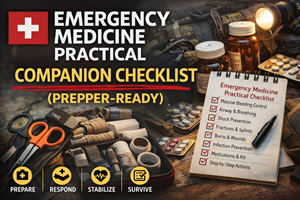
Emergency Medicine Checklist
The Emergency Medicine Practical Companion Checklist (Prepper-Ready) is designed to turn knowledge into action. In an emergency, you don’t have time to think through a long guide—you need a clear, repeatable process you can follow under stress. This checklist acts as your mental shortcut, helping you move quickly through the most critical priorities: stopping bleeding, maintaining breathing, preventing shock, and stabilizing the patient. It removes hesitation and replaces it with structure.
This checklist is not just for individuals—it’s a tool for community readiness. When shared within a group, it creates a common response framework so everyone is on the same page during an emergency. In a real-world crisis, that kind of coordination can make the difference between confusion and effective action.
1. Immediate Response Checklist (0–5 Minutes)
☐ Scene is safe (no ongoing danger)
☐ Check responsiveness (talk, tap)
☐ Call for help / signal others (if possible)
☐ Check airway (clear obstructions)
☐ Check breathing (look, listen, feel)
☐ Check circulation (bleeding, pulse)
IF NOT BREATHING:
☐ Begin CPR
IF BLEEDING HEAVILY:
☐ Apply direct pressure immediately
2. Massive Bleeding Control
☐ Locate source of bleeding
☐ Apply firm direct pressure
☐ Pack wound (if deep)
☐ Apply pressure bandage
IF BLEEDING CONTINUES:
☐ Apply tourniquet (high & tight)
☐ Tighten until bleeding stops
☐ Note time applied
3. Airway & Breathing
☐ Head tilt / chin lift
☐ Remove visible obstructions
☐ Place in recovery position (if unconscious but breathing)
CHEST INJURY:
☐ Apply chest seal
☐ Monitor breathing closely
4. Shock Prevention
☐ Lay patient flat
☐ Elevate legs (if safe)
☐ Keep warm (blanket/clothing)
☐ Reassure patient
☐ Monitor pulse and breathing
5. Fractures & Immobilization
☐ Identify injury location
☐ Immobilize above and below joint
☐ Use splint or improvised support
☐ Avoid unnecessary movement
6. Burns Treatment
☐ Remove from heat source
☐ Cool with clean water (NOT ice)
☐ Cover with sterile dressing
☐ Do NOT pop blisters
7. Wound Care & Infection Prevention
☐ Clean wound thoroughly
☐ Apply antiseptic
☐ Cover with sterile dressing
☐ Change dressing regularly
WATCH FOR:
☐ Redness spreading
☐ Swelling
☐ Pus
☐ Fever
8. Hydration & Electrolytes
☐ Provide clean water
☐ Add electrolytes if available
☐ Encourage small frequent sips
☐ Monitor urine color (dark = dehydration)
9. Medical Kit Essentials Check
Bleeding Control
☐ Tourniquets (2+)
☐ Hemostatic gauze
☐ Compression bandages
Airway
☐ CPR mask
☐ Airway adjunct (if trained)
Wound Care
☐ Gauze
☐ Antiseptic
☐ Tape
Medications
☐ Pain relief
☐ Antihistamines
☐ Anti-diarrheal
☐ Electrolytes
Tools
☐ Trauma shears
☐ Gloves
☐ Tweezers
☐ Thermometer
10. Redundancy Check (Critical for Preppers)
☐ Home medical kit stocked
☐ Vehicle medical kit ready
☐ Bug-out medical kit prepared
☐ EDC (everyday carry) trauma kit available
11. Training & Readiness
☐ CPR trained
☐ First aid trained
☐ Practiced tourniquet use
☐ Practiced splinting
☐ Practiced wound packing
12. Scenario Readiness Check
☐ Severe bleeding response practiced
☐ Fall/injury response plan
☐ Food poisoning plan (hydration focus)
☐ Infection monitoring plan
13. Mental Readiness
☐ Stay calm under pressure
☐ Focus on priorities (Airway → Breathing → Bleeding)
☐ Act immediately (don’t hesitate)
14. Community Preparedness
☐ Identify trained individuals nearby
☐ Share medical knowledge
☐ Establish communication plan
☐ Build mutual aid network
15. Final Reality Check
☐ Can I act without hesitation?
☐ Do I know where my gear is (in the dark)?
☐ Have I practiced recently?
Quick Reference Rule (Memorize This)
Stop bleeding → Keep breathing → Prevent shock → Prevent infection