
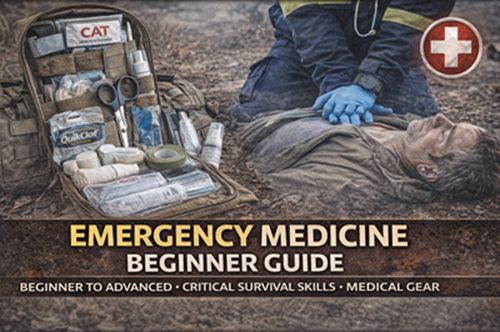
Introduction: Why Emergency Medicine Matters More Than Ever
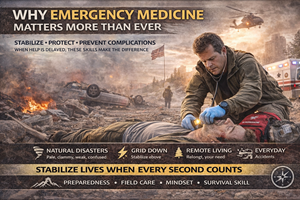 Emergency medicine is not just for doctors, paramedics, or hospitals—it is a core survival skill. In any crisis—natural disaster, grid-down scenario, remote living, or everyday accidents—the ability to stabilize a person in the first minutes can determine survival.
Modern systems create a false sense of security. Ambulances, ERs, and trained professionals are usually minutes away—but in a real emergency, you are the first responder. This guide bridges the gap between basic first aid and advanced field care, giving you the mindset, skills, and structure to act when it matters most.
This is not theory. This is practical, layered capability—from beginner to advanced.
| Section | Title | Focus | Key Skills | Level |
|---|---|---|---|---|
| 1 | Emergency Mindset | Mental readiness and situational control | Awareness, scene safety, stress control | Beginner |
| 2 | Primary Assessment | Identify life-threatening issues fast | ABC, MARCH assessment | Beginner |
| 3 | Beginner Skills | Immediate life-saving actions | Bleeding control, CPR, wound care | Beginner |
| 4 | Intermediate Skills | Stabilization and complication prevention | Shock, fractures, burns, breathing | Intermediate |
| 5 | Advanced Skills | Field-level trauma management | Tourniquets, airway, chest trauma | Advanced |
| 6 | Medical Gear | Tools to support treatment | Kits, trauma gear, equipment selection | All Levels |
| 7 | Off-Grid Medicine | Long-term care without systems | Improvisation, hygiene, recovery care | Intermediate–Advanced |
| 8 | Environmental Threats | Managing heat and cold dangers | Heat stroke, hypothermia prevention | Beginner–Intermediate |
| 9 | Psychological First Aid | Mental stabilization in emergencies | Calming, communication, stress control | All Levels |
| 10 | Training & Practice | Skill retention and realism | Drills, scenarios, repetition | All Levels |
| 11 | Common Mistakes | Avoiding critical errors | Decision-making, reassessment | All Levels |
| 12 | Skill Progression | Building capability over time | Layered training path | All Levels |
SECTION 1: The Emergency Mindset
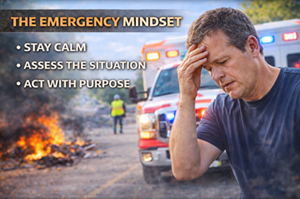 Before any medical skill is applied, the most important tool you have is your mindset. In real emergencies, people don’t fail because they lack knowledge—they fail because they panic, freeze, or make poor decisions under stress. Emergency medicine begins with mental discipline: the ability to stay calm, assess the situation, and act with purpose. This section builds the psychological foundation required to perform under pressure, because without it, even the best training becomes useless.
Situational Awareness
Before medicine comes awareness. Most emergencies are preventable or survivable with:
- Constant scanning of surroundings
- Identifying risks early (tools, terrain, people)
- Knowing exits and escape routes
A prepared person sees problems forming before they happen.
Control the Scene First
Never rush blindly into a situation:
- Ensure the area is safe (fire, traffic, violence)
- Protect yourself (gloves, mask if possible)
- Avoid becoming a second victim
Rule: You are no help if you become the casualty.
Stay Calm Under Pressure
Panic kills. Calm thinking saves lives.
Train yourself to:
- Slow breathing
- Focus on priorities
- Act methodically
SECTION 2: The Primary Assessment (Life Over Everything)
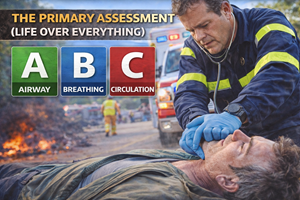 Every second matters in a medical emergency, and this section focuses on what kills first. The primary assessment is designed to quickly identify life-threatening conditions and prioritize treatment in the correct order. Without this structured approach, it’s easy to waste time on minor injuries while missing something fatal. This is the foundation used by military medics, paramedics, and emergency responders worldwide.
This is your first and most important skill.
The ABC Framework
- A – Airway → Is it open?
- B – Breathing → Are they breathing?
- C – Circulation → Are they bleeding?
If any of these fail → death can occur within minutes.
Expanded Trauma Assessment (MARCH Model)
Used in military and advanced prepping:
- M – Massive bleeding
- A – Airway
- R – Respiration
- C – Circulation
- H – Hypothermia / Head injury
This is the gold standard for serious emergencies.
SECTION 3: Beginner Skills (Everyone Should Know)
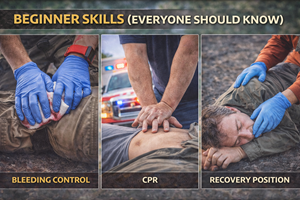 These are the non-negotiable basics. If someone collapses, bleeds out, or stops breathing, these are the skills that save lives in the first critical minutes. This section focuses on simple, high-impact actions that require minimal equipment but deliver maximum results. Everyone—from beginners to experienced preppers—should have these skills fully dialed in.
- Bleeding Control
Uncontrolled bleeding is the #1 preventable cause of death.
Steps:
- Apply direct pressure
- Use cloth, gauze, or bandage
- Elevate if possible
If severe:
- Use a tourniquet (life-saving tool)
- Tighten until bleeding stops
- CPR (Cardiopulmonary Resuscitation)
If no breathing and no pulse:
- Push hard and fast in the center of chest
- 100–120 compressions per minute
- Depth: about 2 inches
Even imperfect CPR is better than none.
- Recovery Position
For unconscious but breathing individuals:
- Roll onto their side
- Keeps airway clear
- Prevents choking
- Basic Wound Care
- Clean with water
- Apply antiseptic if available
- Cover and monitor
Prevent infection early.
SECTION 4: Intermediate Skills (Prepared Individuals)
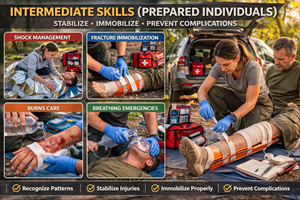 Once you move beyond basic response, you begin managing complex conditions that develop over time. These aren’t always immediately fatal, but if handled incorrectly, they can quickly escalate. This section focuses on recognizing patterns, stabilizing injuries, and preventing complications—especially in situations where help is delayed.
- Shock Recognition & Management
Shock = body failing to circulate blood properly.
Signs:
- Pale, clammy skin
- Rapid pulse
- Confusion
Treatment:
- Lay flat
- Elevate legs (if no trauma)
- Keep warm
- Control bleeding
- Fractures & Immobilization
Broken bones require stabilization:
- Use splints (sticks, boards, gear)
- Immobilize joint above and below
- Do not attempt to “reset” unless trained
- Burns
Burns can kill through fluid loss and infection.
Treatment:
- Cool with water (not ice)
- Cover loosely
- Avoid breaking blisters
Severe burns = medical emergency.
- Breathing Emergencies
Watch for:
- Choking
- Asthma attacks
- Chest trauma
Basic response:
- Open airway
- Assist breathing if trained
- Monitor constantly
SECTION 5: Advanced Skills (Prepper / Field Level)
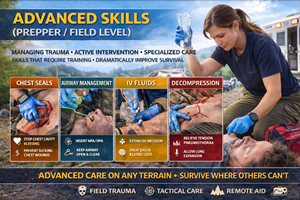 This is where emergency medicine becomes true field medicine. At this level, you are no longer just stabilizing—you are actively managing life-threatening trauma with specialized tools and techniques. These skills require training and practice, but they dramatically increase survival chances in serious situations.
- Tourniquets & Hemostatic Agents
Advanced bleeding control tools:
- Tourniquets (CAT, SOFT-T)
- Hemostatic gauze (QuickClot)
Used for:
- Arterial bleeding
- Severe trauma
- Airway Management
Basic:
- Head tilt / chin lift
Advanced:
- Nasopharyngeal airway (NPA)
- Recovery positioning
- Chest Trauma (Collapsed Lung Awareness)
Penetrating chest wounds can cause lung collapse.
Signs:
- Difficulty breathing
- Uneven chest movement
Treatment:
- Seal wound (occlusive dressing)
- Monitor closely
- Infection Management
In long-term scenarios:
- Clean wounds daily
- Watch for redness, swelling, pus
- Use antibiotics if available and appropriate
Infection kills slowly—but just as effectively.
SECTION 6: Medical Gear (What You Actually Need)
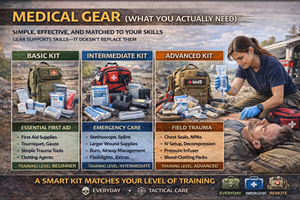 Gear is often overemphasized, but the truth is simple: gear supports skills—it does not replace them. This section breaks down what you actually need at each level, avoiding the common mistake of overcomplicating your setup. A well-built kit is simple, effective, and matched to your level of training.
Beginner Kit
- Gloves
- Gauze
- Bandages
- Antiseptic wipes
- CPR mask
Intermediate Kit
- Tourniquet
- Splinting materials
- Burn dressings
- Trauma shears
Advanced Kit
- Chest seals
- Hemostatic agents
- Airway tools
- IV fluids (advanced users only)
Rule: Gear doesn’t save lives—skills do.
SECTION 7: Off-Grid Emergency Medicine
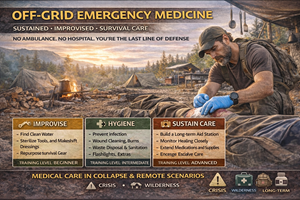 When systems fail, emergency medicine shifts from short-term response to long-term survival care. This section focuses on what happens when there is no ambulance coming and no hospital to rely on. It emphasizes improvisation, hygiene, and sustained care—skills that become critical in collapse or remote scenarios.
When Help Is Not Coming
In a collapse scenario:
- You must stabilize AND manage recovery
- Infection becomes your biggest enemy
- Hygiene becomes critical
Improvised Solutions
- Clean cloth = bandage
- Boiled water = sterilization
- Clothing = splints
Adaptability is survival.
SECTION 8: Environmental Medical Threats
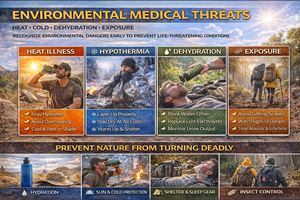 The environment itself can be one of the biggest killers. Heat, cold, dehydration, and exposure can incapacitate or kill faster than many injuries. This section focuses on recognizing environmental dangers early and taking proactive steps to prevent them from becoming life-threatening.
Heat Injuries
- Heat exhaustion
- Heat stroke (life-threatening)
Treatment:
- Cool rapidly
- Hydrate
Cold Injuries
- Hypothermia
- Frostbite
Treatment:
- Warm slowly
- Protect extremities
SECTION 9: Mental & Psychological First Aid
Not all injuries are physical. In many emergencies, psychological breakdown happens before physical failure. Panic spreads quickly, affects decision-making, and can turn manageable situations into disasters. This section focuses on stabilizing the mind—both yours and others.
Emergencies affect the mind as much as the body.
Watch for:
- Panic
- Shock
- Withdrawal
Support with:
- Calm communication
- Reassurance
- Clear instructions
A calm person recovers faster.
SECTION 10: Training & Skill Building
Emergency medicine is a perishable skill. Reading this once is not enough. This section emphasizes repetition, realism, and building muscle memory so that actions become automatic under stress.
You Cannot Learn This Once
Skills fade quickly.
Practice:
- Bandaging
- CPR drills
- Scenario training
Train Under Stress
Real emergencies are chaotic:
- Practice in low light
- Practice with noise
- Practice under pressure
SECTION 11: Common Mistakes to Avoid
Mistakes in emergency medicine are often simple—but deadly. This section highlights the most common errors people make and how to avoid them. Awareness of these pitfalls can dramatically improve outcomes.
- Waiting too long to act
- Ignoring bleeding
- Not checking airway
- Poor hygiene → infection
- Overconfidence without training
SECTION 12: From Beginner to Advanced – The Path
Emergency medicine is a progression, not a destination. This final section shows how to build capability over time, layering skills and knowledge in a practical way that actually translates to real-world readiness.
Beginner
- Learn ABCs
- Practice CPR
- Build basic kit
Intermediate
- Learn trauma response
- Understand shock
- Expand gear
Advanced
- Train regularly
- Learn field medicine concepts
- Build redundancy
Conclusion: The Reality of Emergency Medicine
Emergency medicine is not about being perfect—it’s about doing the right thing fast enough.
- Minutes matter
- Calm matters
- Knowledge matters
Most people freeze.
Prepared people act.
And in a real emergency…
The difference between life and death is often the person standing closest.
Disclaimer
This content is provided for informational and educational purposes only and is not intended as medical advice, diagnosis, or treatment. Emergency medicine techniques described in this guide should only be performed by individuals with appropriate training and within the limits of their knowledge and skill level.
In a medical emergency, always seek professional medical assistance immediately when available. The authors and publishers of this content assume no responsibility or liability for any injury, loss, or damage resulting from the use or misuse of the information provided.
Some techniques discussed may involve risk if performed incorrectly. Users are strongly encouraged to pursue hands-on training from qualified instructors and follow all applicable laws, regulations, and safety guidelines in their area.
By using this information, you acknowledge that you are personally responsible for your actions and decisions.