
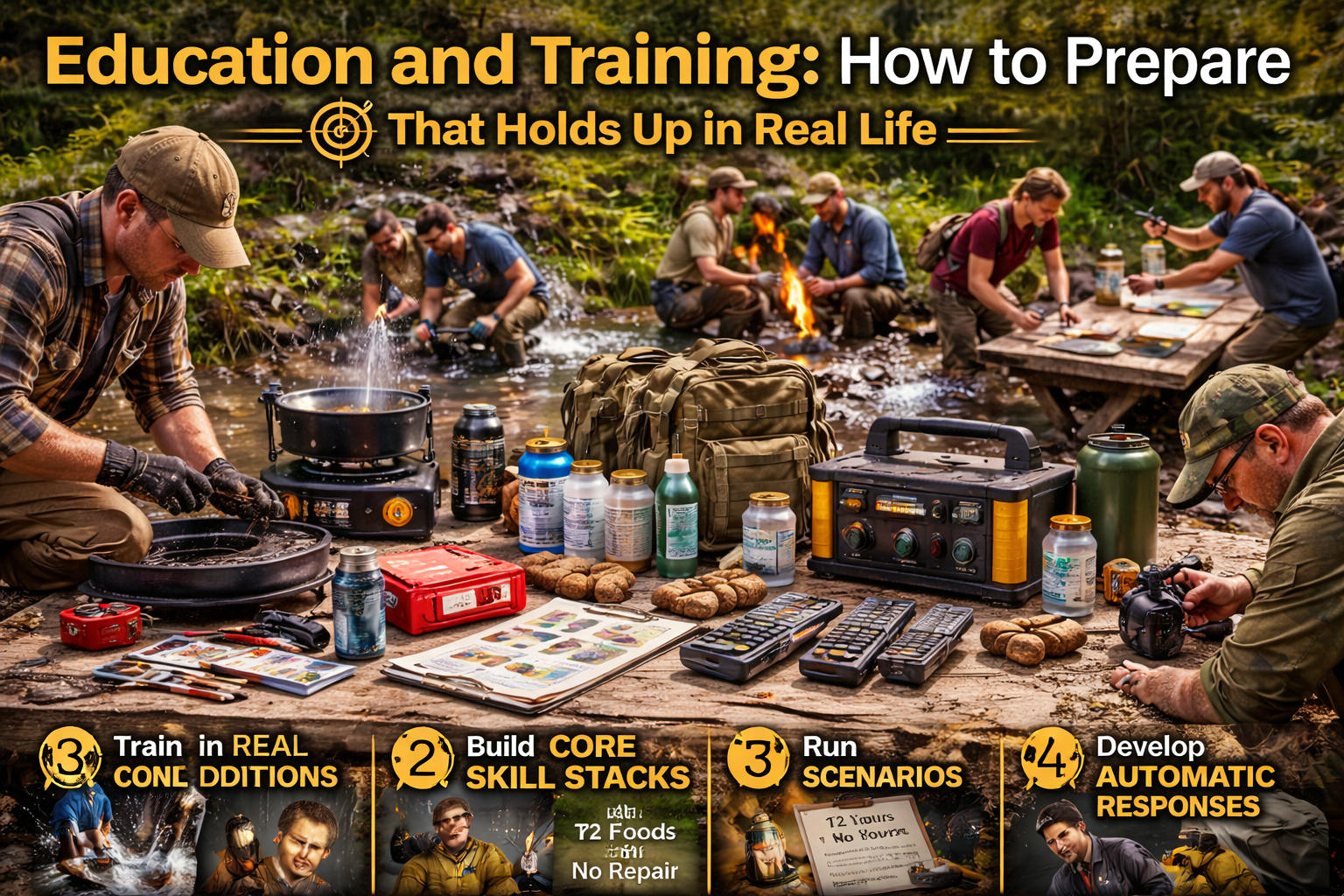
Education and Training: How to Prepare (That Holds Up in Real Life)
Most people prepare by buying things.
Very few prepare by training.
And when things go wrong, training is what actually carries you.
Because gear can fail.
Plans can change.
But what you know — and what you’ve practiced — stays with you.
The Shift: From Information → Capability
Reading about preparedness isn’t the same as being prepared.
At this level, you’re not asking:
“What should I learn?”
You’re asking:
“What can I do, under stress, without thinking?”
1. Build Training Around FAILURE, Not THEORY
Most training looks like this:
- first aid course
gardening basics
survival videos
That’s surface-level.
Instead, train for what actually breaks
Example: Power Outage
Failure chain:
- No lights
No communication
No cooking
No heat
Training should look like:
Practice moving through your house in the dark
Cook a full meal without power
Run your backup lighting for a full night
Go 24 hours using only backup systems
Training = doing, not learning
2. Train in CONDITIONS, Not COMFORT
Most people practice when it’s easy.
That doesn’t translate.
Train in:
Cold
Dark
Rain
Fatigue
Reality Check
Can you set up your gear with gloves on?
Can you function when you’re tired?
Can you solve problems when frustrated?
That’s real training
3. Build “CORE SKILL STACKS”
Instead of random skills, build stacks that support each other.
- Core Stack 1: Water
Finding water
Filtering water
Carrying water
Rationing water - Core Stack 2: Food
Cooking basics
Food storage
Preservation (canning/drying)
Improvised cooking - Core Stack 3: Repair
Basic mechanical repair
Electrical basics
Improvisation
👉 Skills should overlap and reinforce each other
4. ADD TIME-BASED TRAINING (Almost Nobody Does This)
Train based on duration.
0–24 Hours
Immediate response
Stabilization
Communication
1–3 Days
Resource management
Routine building
Energy conservation
3–14 Days
Adaptation
System rotation
Skill reliance
👉 Your behavior should change over time — training should reflect that
5. BUILD “AUTOMATIC RESPONSES”
In real situations, you don’t think clearly.
You need:
Default actions
Pre-decided steps
No hesitation
Example
Instead of:
“What should I do?”
You already know:
“Power out → grab headlamp → check systems → switch to backup”
That only comes from repetition
6. TRAIN WITH YOUR ACTUAL GEAR
Big mistake people make:
They train with nothing… and expect to perform with gear.
You should:
Cook with your backup stove
Use your water filter regularly
Rotate your food
Run your power systems
If you haven’t used it, you don’t understand it
7. INCLUDE HUMAN FACTORS (CRITICAL)
This is where most training fails.
Reality:
Stress slows thinking
Fatigue causes mistakes
Fear changes behavior
Train for:
Staying calm under pressure
Making decisions quickly
Managing limited energy
This matters more than gear
8. TRAIN WITH OTHERS (GAME CHANGER)
Solo training has limits.
Add:
Family drills
Group scenarios
Role assignments
Example
One person handles water
One handles food
One handles security
Coordination beats chaos
9. ADD “LOCAL TRAINING” (Tie to Your 3-Mile Concept)
This is powerful.
Train in your actual environment
Walk your 3-mile radius
Identify resources
Practice routes
Ask:
Where is water nearby?
What are the bottlenecks?
What slows movement?
Preparedness is local
10. BUILD “SKILL REDUNDANCY”
Just like gear redundancy.
Example: Fire
Lighter
Ferro rod
Natural methods
If one fails, another works
11. CREATE TRAINING SCENARIOS
This is where it becomes real.
Run scenarios like:
“No power for 48 hours”
“No water for 24 hours”
“Can’t leave the house”
“Must move with limited gear”
Simulate it — don’t imagine it
12. FINAL ADVANCED RULE
Train until simple things are automatic
Not:
❌ “I think I could do that”
But:
✅ “I’ve already done that multiple times”
Final Thought (Advanced Mindset)
At this level:
You’re not collecting knowledge.
You’re building:
capability
confidence
consistency
Gear supports you
Skills carry you
Training makes it automatic
Most people prepare once.
Advanced preppers:
train continuously