
Category: Economy
Focus: Water • Crisis • Skills • Prepping • Security
Objective: Build real financial resilience that holds up when systems fail—not just when things are normal
1. THE REAL ECONOMY YOU LIVE IN (NOT THE ONE ON TV)
Most people think “the economy” is:
- stock markets
- interest rates
- government policies
But your real economy is:
- can you afford food
- can you access fuel
- can you keep your home running
- can you adapt if income drops
That’s it.
The biggest mistake people make is preparing for the wrong economy.
2. MISTAKE #1: TRUSTING THE SYSTEM WILL HOLD
Most people assume:
- banks will always function
- stores will always restock
- digital payments will always work
History says otherwise.
What actually happens:
- systems slow down
- access gets limited
- rules change
You don’t lose money—you lose access.
Fix:
- keep some cash accessible
- build physical reserves (food, water, fuel)
- don’t rely on one system
3. MISTAKE #2: HOLDING TOO MUCH CASH
People think cash = safety
Reality:
- inflation eats it slowly
- purchasing power drops every year
Example:
- $100 today ≠ $100 in 2–3 years
Fix:
- keep 3–6 months cash only
- convert excess into:
- food storage
- tools
- durable goods
- practical assets
if it holds value or keeps you alive, it’s better than idle cash
4. MISTAKE #3: NO BUFFER
Living paycheck to paycheck is the biggest vulnerability.
What happens in a disruption:
- job loss
- reduced hours
- delayed payments
You go from stable → crisis instantly
Fix:
Start small:
- $20/week into reserves
- cut one unnecessary expense
- build toward 30 → 60 → 90 day buffer
5. MISTAKE #4: RELYING ON ONE INCOME
One job = one point of failure
In instability:
- layoffs happen fast
- industries shift
Fix:
Build redundancy:
- side income
- tradeable skills
- small business capability
Examples:
- repairs
- food production
- resale
income diversification = survival
6. MISTAKE #5: IGNORING SKILLS
Most people try to solve everything with money.
But when:
- supplies are limited
- services are unavailable
money doesn’t solve the problem
Fix:
Learn:
- gardening
- food preservation
- water purification
- basic repairs
skills replace spending
7. MISTAKE #6: NO SUPPLY BUFFER
This is where most people fail fast.
They rely on:
- weekly shopping
- just-in-time supply chains
What Happens:
- shelves empty
- prices spike
- panic buying
Fix:
Build:
- 30-day supply (minimum)
- 90-day (goal)
Focus on:
- food
- water
- hygiene
- fuel
8. MISTAKE #7: IGNORING PRICE SIGNALS
The system gives warnings:
- rising food prices
- fuel increases
- shortages
Most people ignore them.
Fix:
Track:
- 5–10 core items you use
- watch trends
when prices rise → buy ahead
9. MISTAKE #8: OVER-RELIANCE ON DIGITAL MONEY
Everything digital = control + vulnerability
Risks:
- outages
- restrictions
- monitoring
Fix:
- keep some cash
- diversify access
- don’t rely on one payment method
10. MISTAKE #9: DEBT TRAPS
Debt works in stable times
It kills in unstable ones
Why:
- interest compounds
- income drops
- payments remain
Fix:
- eliminate high-interest debt first
- avoid new unnecessary debt
- prioritize ownership
11. MISTAKE #10: NO BARTER STRATEGY
People assume:
cash will always work
Reality:
- shortages shift value
- goods > currency
Fix:
Store small trade items:
- lighters
- batteries
- hygiene products
- tools
these become high-value items
12. MISTAKE #11: IGNORING LOCAL ECONOMY
Global systems fail first
Local systems last longer
Fix:
- connect with local:
- farmers
- tradespeople
- suppliers
relationships = access
13. MISTAKE #12: NO LONG-TERM PLAN
Most people think short-term:
- next paycheck
- next bill
Preppers think:
- what if costs double?
- what if income drops 50%?
Fix:
Plan for:
- inflation
- shortages
- reduced access
14. THE REAL ECONOMIC MODEL (WHAT WORKS)
You need 4 layers:
1. ACCESS LAYER
- food
- water
- essentials
2. BUFFER LAYER
- emergency cash
- supplies
3. SKILL LAYER
- ability to produce or repair
4. NETWORK LAYER
- community
- trade
this replaces dependence on fragile systems
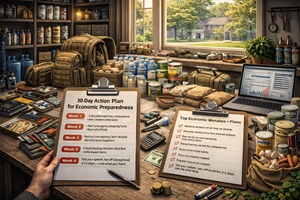
15. 30-DAY ACTION PLAN
WEEK 1
- calculate expenses
- start emergency fund
- buy extra food
WEEK 2
- reduce one expense
- build supply buffer
- identify local resources
WEEK 3
- start side income idea
- build skill
WEEK 4
- test your system:
- eat from storage
- limit spending
16. ADVANCED INSIGHT
Economic collapse is not a moment.
It’s a progression:
- prices rise
- access tightens
- shortages appear
- panic begins
by step 3, it’s too late to prepare cheaply
17. FINAL TAKEAWAY
You don’t need to be rich.
You need to be:
- prepared
- adaptable
- less dependent
If you:
- reduce reliance
- build buffers
- learn skills
- store essentials
you move ahead of 90% of people