
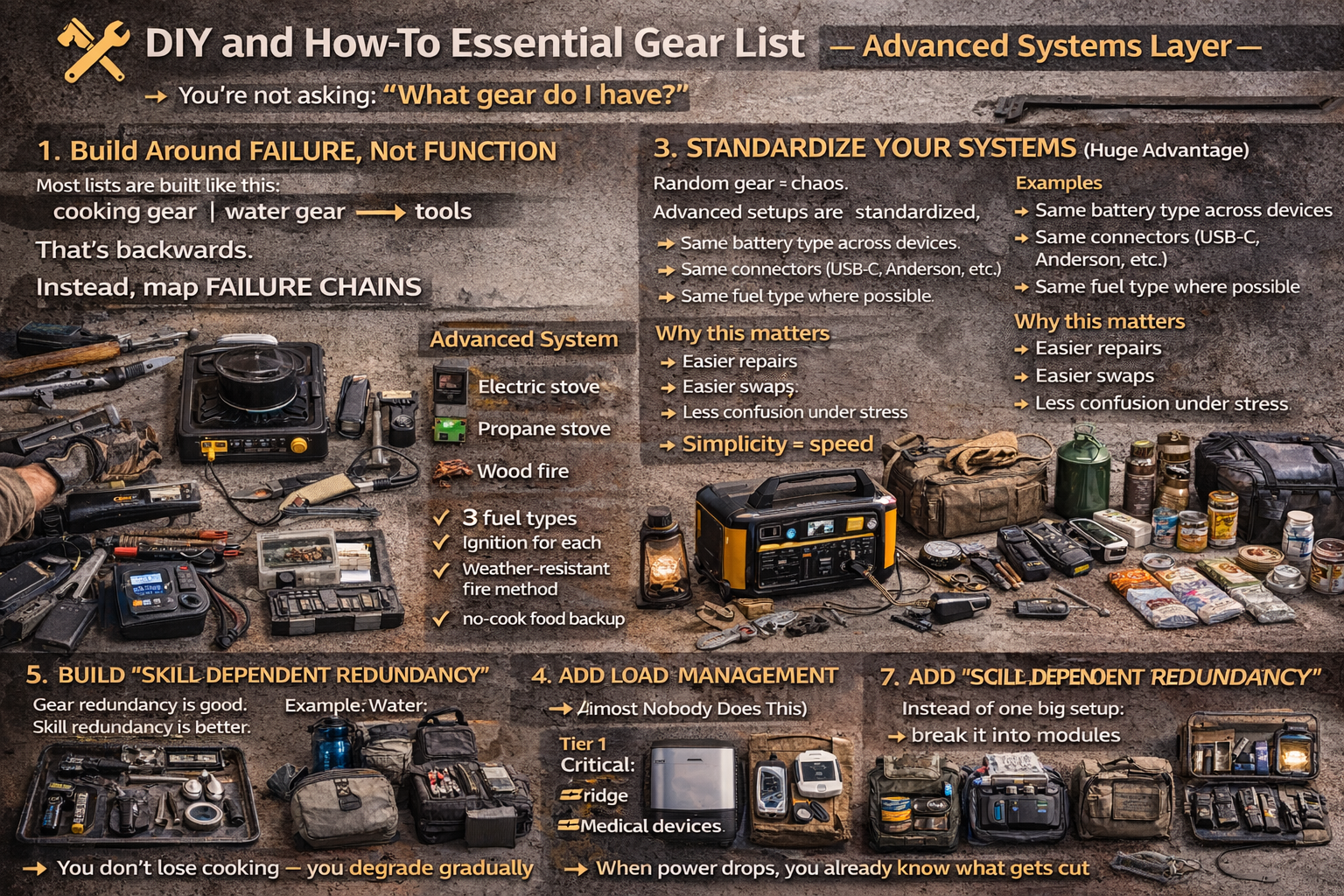
DIY and How-To Essential Gear List — Advanced Systems Layer
At this level, you’re not asking:
“What gear do I have?”
You’re asking:
“What fails first, and how do I stay operational anyway?”
1. Build Around FAILURE, Not FUNCTION
Most lists are built like this:
- cooking gear
water gear
tools
That’s backwards.
Instead, map FAILURE CHAINS
Example: Cooking
Failure chain:
Power out → stove useless
Propane runs out → stove useless
Weather → fire difficult
Advanced System
Primary: Electric stove
Secondary: Propane
Tertiary: Wood fire
Emergency: Cold food fallback
Checklist becomes:
✔ 3 fuel types
✔ ignition for each
✔ weather-resistant fire method
✔ no-cook food backup
You don’t lose cooking — you degrade gradually
2. Add “FIELD REPAIR CAPABILITY” (Critical)
Most gear fails not because it breaks…
but because you can’t fix it on the spot
Upgrade your repair kit to FIELD LEVEL
Not just tools — problem-solving capability
Add:
- Spare wiring + connectors
Hose repair kit
Patch kits (fabric, plastic, rubber)
Universal fasteners
Sealants (silicone, epoxy)
Advanced Rule
If it fails, you fix it without leaving your location
3. STANDARDIZE YOUR SYSTEMS (Huge Advantage)
Random gear = chaos.
Advanced setups are standardized.
Examples
- Same battery type across devices
Same connectors (USB-C, Anderson, etc.)
Same fuel type where possible
Why this matters
Easier repairs
Easier swaps
Less confusion under stress
Simplicity = speed
4. ADD LOAD MANAGEMENT (Almost Nobody Does This)
This is where power systems fail.
Ask yourself:
“What actually deserves power?”
Create a Power Priority List
Tier 1 (Critical):
- fridge
medical devices
Tier 2 (Important)
- phone
lighting
Tier 3 (Comfort):
- fans
extras
When power drops, you already know what gets cut
5. BUILD “SKILL-DEPENDENT REDUNDANCY”
Gear redundancy is good.
Skill redundancy is better.
Example: Water
Filter → gear
Boiling → basic skill
Solar still → advanced skill
Natural sourcing → knowledge
If gear fails, skills take over
6. ADD ENVIRONMENTAL STRESS TESTING
Most people prep in perfect conditions.
That’s useless.
Test your gear in:
Cold
Dark
Wet
Under time pressure
Example
Can you set up your stove in the dark?
Can you access gear with gloves on?
This is where setups break
7. CREATE “GRAB-AND-GO MODULAR SYSTEMS”
Instead of one big setup:
break it into modules
Example Modules
Water module
Medical module
Power module
Cooking module
Each should be:
self-contained
portable
usable independently
This gives you flexibility under pressure
8. ADD HUMAN PERFORMANCE FACTOR
This is where advanced prepping separates itself.
Reality:
Stress reduces thinking
Fatigue causes mistakes
Cold drains energy
Checklist Additions
✔ Easy-access gear (no digging)
✔ Simple systems (no complex setup)
✔ Low-effort solutions (less physical drain)
The best system is the one you can run when you’re exhausted
9. PLAN FOR “RESOURCE CONVERSION”
This is elite-level thinking.
Example
Instead of:
“I need fuel”
Think:
“What can become fuel?”
Examples
Wood → heat / cooking
Alcohol → fuel
Trash → burnable material
You’re not limited to what you stored
10. INTEGRATE WITH YOUR 3-MILE REALITY
Tie this back to your video (this is powerful).
Ask:
What tools support staying local?
What tools reduce travel?
What tools help my immediate area?
Examples
Cart for moving supplies
Tools for repairing local infrastructure
Gear for sharing with neighbors
The goal isn’t movement
The goal is stability where you are
11. BUILD “SILENT MODE” CAPABILITY
Most people overlook this.
Ask:
Is my setup loud?
Does it attract attention?
Add:
Quiet power (battery vs generator)
Low-light options
Low-profile cooking
Sometimes survival = not being noticed
12. FINAL ADVANCED RULE
👉 Every system should fail gracefully
Not:
❌ “It stops working”
But:
✅ “It gets weaker, but still works”
Final Thought (True Advanced Mindset)
At this level:
You’re not preparing for a scenario.
You’re preparing for:
- uncertainty
system failure
human limits
- Gear supports you
- Skills carry you
- Systems keep you going