
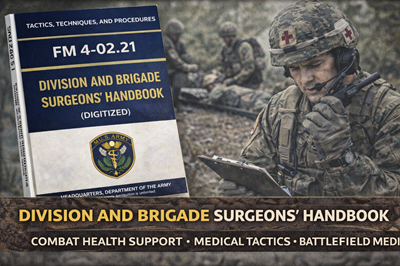
DIVISION AND BRIGADE SURGEONS HANDBOOK (DIGITIZED) HEADQUARTERS, DEPARTMENT OF THE ARMY DISTRIBUTION RESTRICTION: Approved for public release; distribution is unlimited.
The Division and Brigade Surgeons’ Handbook (FM 4-02.21) is a comprehensive field manual that defines how medical operations are planned, coordinated, and executed at the highest tactical levels of military operations. Developed by the U.S. Army, this publication focuses on the structure, responsibilities, and real-world functions of division and brigade medical staff, providing a detailed framework for delivering effective combat health support (CHS) in complex and dynamic environments .
At its core, the manual outlines the critical role of the division and brigade surgeons as both medical leaders and operational advisors. These individuals are responsible not only for overseeing medical treatment, but also for advising commanders on everything from disease prevention and environmental hazards to casualty management and medical logistics. As shown in Chapter 1, the division surgeon plays a central role in coordinating medical activities, ensuring readiness, and maintaining the overall health of the force . This highlights that battlefield medicine is not just about treatment—it’s about strategy, planning, and prevention.
The handbook also provides an in-depth look at combat health support operations, including planning for mass casualties, coordinating evacuation systems, managing medical supplies (Class VIII), and integrating medical units into broader operational plans. It emphasizes the importance of communication and coordination between medical staff and other command elements, ensuring that medical support is synchronized with the mission. The detailed breakdown of organizational structures—such as the Division Surgeon’s Section (DSS) and Brigade Surgeon’s Section (BSS)—demonstrates how medical operations are structured to function efficiently under pressure .
Beyond military applications, this manual offers valuable insight for preppers, emergency planners, and those interested in large-scale crisis response. It shows how to think about medical support not just at the individual level, but at the system level—planning for logistics, personnel, communication, and sustained operations. In any scenario involving disaster response or prolonged disruption, the principles in this handbook provide a powerful blueprint for building organized, scalable, and resilient medical support systems.