

If your were miles from the nearest hospital, deep in the backcountry, and you were accidentally wounded, what would you do? What would you do when a hunting knife slips into your leg, or your friend accidentally gashes their arm? Blood is pooling fast, panic is rising faster, and every pair of eyes locks onto you like you’re the last lifeline in a storm.
For most of us, the idea of stitching up a wound without a doctor present sounds like something out of a war movie — something only a battlefield medic or a rugged frontier surgeon should attempt. But history tells a different story. Before ambulances had sirens and hospitals dotted every county, people had to know how to close wounds, stop bleeding, and prevent infection. And today, in a world where medical help isn’t always a 911 call away — whether you’re off-grid, in a disaster zone, or facing a collapse scenario — those skills aren’t just useful. They’re essential. So let’s break it down — step by step, myth from fact, panic from purpose — because when the moment comes, hesitation isn’t a luxury you can afford. Here’s a crash course on off-grid wound care.
Key points:
-
- Bleeding is enemy number one — stop it fast with direct pressure, tourniquets as a last resort, and hemostatic agents if available.
-
- A dirty wound is a deadly wound — clean it like your life depends on it (because it might).
-
- Not every wound needs stitches — butterfly bandages and sterile strips can save the day (and the skin).
-
- Suturing is a skill, not a mystery — with sterile tools, the right knot, and steady hands, even a novice can close a wound.
-
- Infection is the silent killer — watch for redness, heat, pus, and foul smells, and act fast if they appear.
-
- Nature’s first aid kit beats nothing at all — honey, alcohol (for cleaning, not drinking), and boiled water have saved lives for centuries.
- Legal protections exist, but so do limits — Good Samaritan laws cover well-meaning helpers, but don’t play hero beyond your training.
First things first: The bleeding has to stop
Blood is dramatic. It’s messy, it’s terrifying, and if it’s pumping out of someone like a fountain, your window to act is small. The human body holds about 1.2 to 1.5 gallons of blood. Lose a third of that, and the body starts shutting down. Lose half? It’s often fatal. So before you worry about stitches, sterilization, or anything else, the bleeding stops. Period.
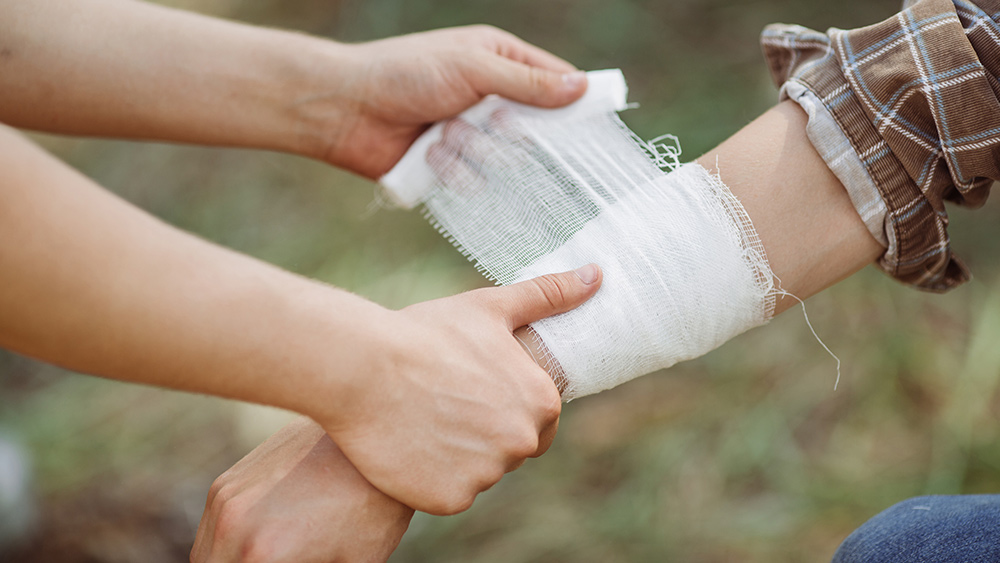
Direct pressure is your best friend. Grab the cleanest cloth you have — sterile gauze if you’re lucky, a bandana if you’re not — and press it hard against the wound. Don’t peek. Don’t lift it to check. Just press. If blood soaks through, add another layer on top and keep pressing. Most bleeding will slow or stop within a few minutes.
But what if it doesn’t? That’s when you escalate. Hemostatic gauze, impregnated with clotting agents like chitosan or zeolite, can be a game-changer. Pack it into the wound and hold pressure. No hemostatic gauze? A tampon works in a pinch. It’s designed to absorb blood and can be pressed into a deep wound.
If the bleeding is from an artery — bright red, spurting with each heartbeat — you’re in critical territory. Tourniquets save limbs (and lives) but at a cost. Apply it above the wound (between the injury and the heart), tighten until the bleeding stops, and write the time on the patient’s skin. Tourniquets cut off circulation, and after about two hours, tissue starts dying. If you can’t get to a hospital, you’ll have to loosen it periodically to restore blood flow, but that risks restarting the bleeding. It’s a brutal trade-off, but it beats bleeding out.
Cauterization is the nuclear option. Heating a metal object (a knife, a spoon, even a heated rock) and pressing it to a bleeding vessel can seal it shut. It’s agonizing, it smells like burning flesh, and it leaves a nasty scar — but if it’s the only way to stop a life-threatening bleed, it’s been done for centuries. (The ancient Greeks used red-hot irons. You work with what you’ve got.)
Access the Full Article from Natural News