
Did you know that certain plants actually get along better with each other than others? Some plants support each others growth, while others are best kept far apart. Just like people! Read on to learn more about what plants bring out the best in your tomatoes, and which ones will actually hinder them.
Tomato Friends
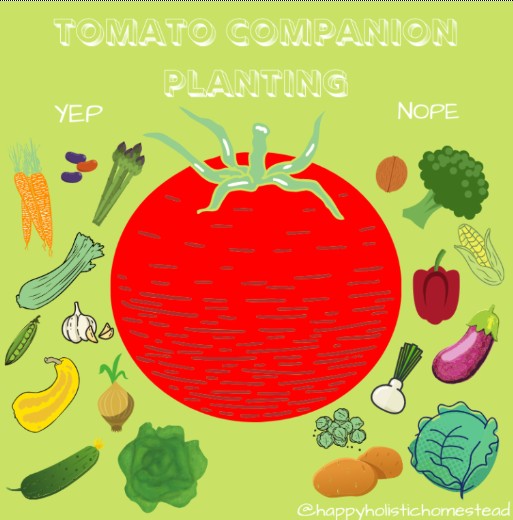
Carrots and tomatoes complement eachothers growth habits. Carrots like cooler temps and tomatoes will provide them with shade. Lettuce can also be a good companion for tomatoes for this reason. With both lettuce and carrots, they will grow better planted early (and harvested soon after tomatoes go in) or late (and harvested after tomatoes are done) in the season. Amaranth helps to repel insects.
Basil and borage are also said to repel insects and improve the flavor and vigor of tomato plants. I like to plant at least one basil for every tomato plant and a couple of borage plants in a large tomato bed. Garlic repels red spider mites. Marigolds repel a plethora of insects, including slugs and nematodes. Mint is an excellent garden companion, repelling many insects, but it can also be invasive. Grow in pots to keep the roots from spreading, and cut back frequently to keep it from dropping seeds. Parsley attracts hoverflies, which feed on tomato pests.
Dill can be be grown with tomatoes to enhance flavor and growth when young, but once dill matures it inhibits tomato growth and should be pulled out. Nasturtium is also good at repelling pests and may help prevent fungal disease. Asparagus and tomatoes have a mutually beneficial relationship as asparagus produces a chemical that kills nematodes and tomatoes repel the asparagus beetle. Tomatoes will repel insects that feed on gooseberry plants and will protect roses from black spot. Other plants that are benficial to tomatoes: calendula, celery, chives, cosmos, cucumber, lemon balm (can be invasive), onions, nettle, squash, and thyme (I love using thyme as a ground cover or living mulch all over the garden).
https://happyholistichomestead.com/2020/03/05/companion-planting-tomatoes/#more-1587