
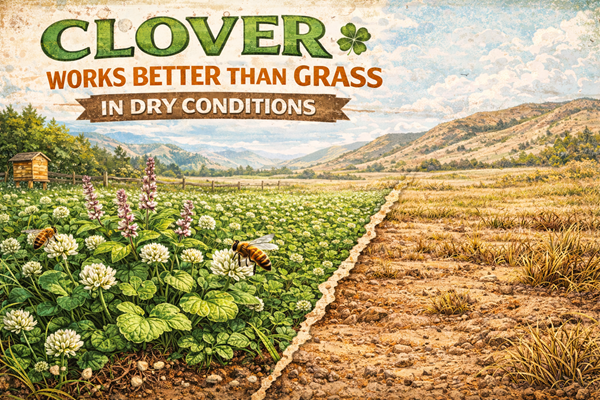
A Practical Prepper Guide to Building a Resilient, Low-Water Lawn
Introduction: Why Your Lawn Keeps Failing
If you live in a dry, arid region, you’ve probably already experienced it: grass looks great in early spring, struggles by mid-summer, and by late season, you’re staring at dry patches, dust, and disappointment. No matter how much you water, fertilize, or reseed, traditional turf grass simply isn’t designed for these conditions.
This isn’t a failure on your part—it’s a mismatch between plant and environment.
Grass lawns were designed for high-rainfall regions with rich soil and consistent moisture. When you try to force that system into a dry climate, it becomes a constant battle. Clover, on the other hand, flips the equation. Instead of fighting the environment, it works with it.
The Core Idea: Stop Fighting the Environment
The biggest shift in mindset is this: instead of trying to maintain a perfect lawn, focus on building a system that thrives naturally in your conditions.
Clover is one of those systems.
It doesn’t just survive in dry environments—it adapts, improves the soil, and creates a self-sustaining ground cover that requires far fewer inputs. This makes it ideal not just for homeowners, but for anyone thinking in terms of long-term resilience, self-sufficiency, and reduced dependency on external resources.
What Makes Clover Different
Clover is not just a “replacement” for grass—it behaves differently at a biological level. It forms a dense, low-growing ground cover that retains moisture, shades the soil, and actively improves the environment it grows in.
Unlike grass, which extracts nutrients from the soil, clover actually contributes to it. Its roots host beneficial bacteria that pull nitrogen from the air and convert it into a usable form for plants. Over time, this transforms poor soil into fertile ground.
This means your lawn isn’t just surviving—it’s improving year after year.
Drought Resistance: The Game Changer
One of the biggest advantages of clover is its ability to handle drought conditions.
In a dry climate, water is the limiting factor. Grass depends heavily on consistent watering to stay green and alive. Clover, however, has deeper and more adaptive root systems that allow it to access moisture more efficiently.
During dry periods, clover may slow its growth or temporarily lose some vibrancy, but it rarely dies off the way grass does. When moisture returns, it rebounds quickly, often without the need for reseeding.
This resilience makes it far more reliable in unpredictable conditions.
Water Use: A Critical Comparison
In regions where water restrictions are common or irrigation is limited, this difference becomes even more important.
Grass lawns often require frequent watering to maintain their appearance. Clover can thrive with significantly less water, making it a better long-term solution for areas facing water scarcity.
Over time, this translates into lower costs, less maintenance, and reduced dependence on external water sources.
Soil Improvement: Clover Builds, Grass Depletes
One of the most overlooked benefits of clover is its ability to improve soil quality.
Grass consumes nutrients and often requires synthetic fertilizers to maintain growth. Clover does the opposite—it adds nitrogen to the soil naturally. This not only supports its own growth but also benefits surrounding plants.
As clover spreads, it gradually transforms the soil into a richer, more balanced ecosystem. This is especially valuable in areas where soil can be rocky, dry, and low in organic matter.
Weed Suppression: Nature Does the Work
Clover grows thick and spreads quickly, creating a dense mat that leaves little room for weeds to take hold.
Instead of constantly battling weeds with chemicals or manual removal, clover reduces the problem naturally. By covering the ground and competing for space, it prevents unwanted plants from establishing themselves.
This reduces maintenance and creates a cleaner, more uniform appearance over time.
The Bee Factor: A Living, Breathing Ecosystem
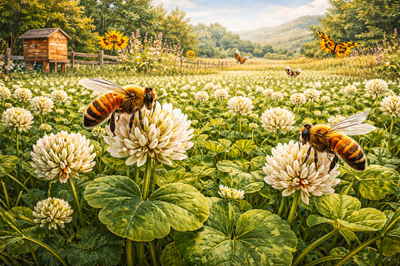 One of the most exciting aspects of a clover lawn is what it brings to life.
When clover blooms, it produces small white or pink flowers that attract bees and other pollinators. These insects are essential for food production, supporting everything from backyard gardens to larger agricultural systems.
A traditional grass lawn is essentially a biological desert. A clover lawn, by contrast, becomes an active part of the ecosystem.
Yes, you’ll see more bees—but that’s a sign of a healthy environment. With a little awareness (like wearing shoes when walking through flowering areas), this becomes a benefit rather than a drawback.
Maintenance: Less Work, More Results
Clover requires far less maintenance than grass.
It doesn’t need frequent mowing, and when it is cut, it regrows evenly without the patchiness often seen in grass lawns. It also doesn’t require constant fertilization or chemical treatments.
This makes it ideal for anyone looking to reduce time, effort, and reliance on external inputs.
A More Natural Look
Clover lawns have a different aesthetic. Instead of the uniform, manicured look of grass, they offer a softer, more natural appearance.
The texture is lush and green, often staying vibrant longer into dry periods. When in bloom, the small flowers add visual interest and a sense of life to the space.
For those willing to move away from the “golf course” ideal, the result is often more appealing and functional.
Feature Comparison Chart
| Feature | Clover | Grass |
|---|---|---|
| Water Needs | Low | High |
| Drought Resistance | High | Low |
| Fertilizer Needs | Minimal (self-fertilizing) | Frequent |
| Maintenance | Low | High |
| Soil Improvement | Yes | No |
| Weed Resistance | Strong | Weak |
| Pollinator Support | Excellent (bees) | None |
The Prepper Perspective: Why This Matters
A clover lawn is more than landscaping—it’s a shift toward resilience.
It reduces dependence on:
- Water systems
- Chemical fertilizers
- Constant maintenance
It improves:
- Soil quality
- Ecosystem health
- Long-term sustainability
For anyone thinking beyond short-term convenience, this is a clear upgrade.
Transitioning from Grass to Clover
You don’t need to rip everything out overnight. In fact, one of the best strategies is to overseed clover into your existing lawn.
Over time, clover will naturally take over weaker areas while blending with remaining grass. This creates a hybrid system that balances durability and resilience.
Low-traffic areas can transition fully to clover, while high-use zones can remain mixed.
Final Thoughts: A Smarter System
Grass lawns are high-input systems that struggle in dry environments. Clover offers a low-input alternative that works with nature rather than against it.
It’s greener with less water.
It improves your soil instead of draining it.
It supports bees and life instead of excluding them.