
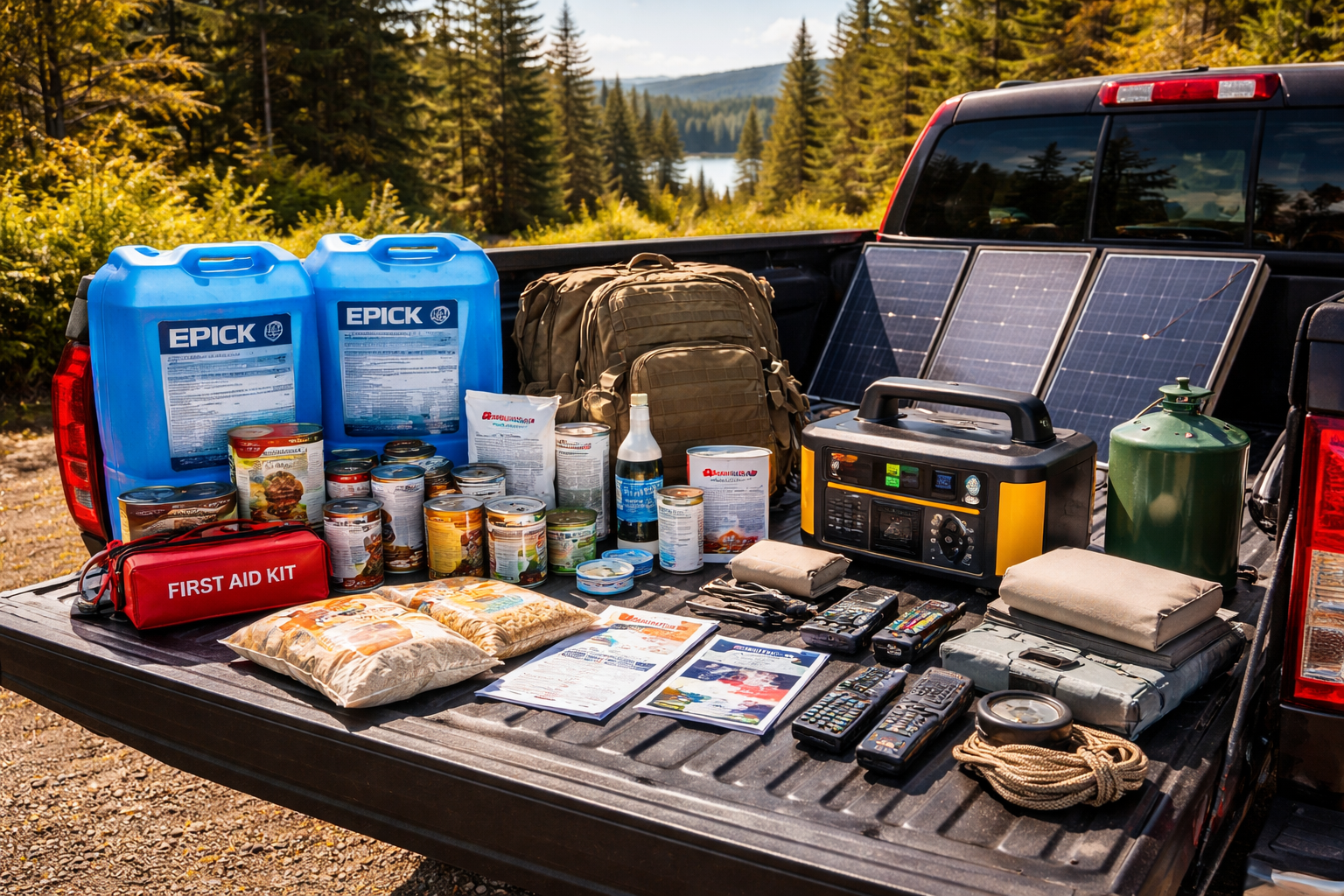
Most checklists stop at items.
Advanced preparedness moves beyond that:
You’re not tracking gear — you’re managing systems, failure points, and decision triggers
Level Up #1: Turn Checklists Into SYSTEMS
Instead of:
“Do I have water?”
You think:
“What breaks my water system, and what happens next?”
Example: Water (Advanced)
Primary System
Stored water (X days)
Failure Points
- Contamination
Running out
Container damage
Backup Systems - Gravity filter
Boiling
Chemical treatment
Tertiary
Nearby water source mapped
Rain catchment
Checklist becomes:
✔ Stored water (X days)
✔ Filter tested monthly
✔ Fuel for boiling
✔ Backup purification tablets
✔ Water source within 3 miles identified
Now you’re not just “prepared” — you’re resilient
Level Up #2: Add TIME-BASED CHECKLISTS
Most people don’t plan by time.
You should.
Phase-Based Planning
Phase 1: 0–24 Hours
- Lock down location
Fill containers
Charge everything
Gather intel
Phase 2: 1–3 Days - Ration food/water
Establish routine
Reduce movement
Phase 3: 3–14 Days
- Transition to sustainability
Expand resource use
Start local coordination
Phase 4: 2+ Weeks
- Long-term adaptation
Barter / production
Community reliance
Your checklist should change based on time
Level Up #3: Add TRIGGERS (This is elite-level)
Most people react too late.
You don’t.
You define triggers:
- Example Triggers
“If power is out for 6 hours → switch to backup lighting system”
“If stores show shortages → increase water storage immediately”
“If fuel drops below 50% → stop non-essential travel”
“If outage hits 48 hours → shift to ration mode”
This removes hesitation and guessing
Level Up #4: Add WEIGHT & MOBILITY CHECKLISTS
Your video topic ties perfectly here.
Most people ignore this.
Mobility Reality Check
Can you carry your gear for 3 miles?
Can you do it under stress?
Can you do it with kids?
Checklist Add-On
✔ Bug-out bag weight tested
✔ Can walk 3 miles with load
✔ Alternate routes mapped
✔ Drop points / rest points identified
This is where plans fail in real life
Level Up #5: Add REDUNDANCY TIERS
Everything important gets 3 layers:
- Example: Cooking
Primary → Electric
Secondary → Propane stove
Tertiary → Fire / solid fuelExample: Lighting
Primary → Grid
Secondary → Battery lights
Tertiary → Candles / oil lampsIf it matters, it gets layers
Level Up #6: Add HUMAN FACTORS (Most Overlooked)
Gear doesn’t fail first.
People do.
Checklist Add-On
✔ Sleep plan
✔ Stress management
✔ Roles assigned (who does what)
✔ Communication plan
Example
Who handles water?
Who manages food?
Who watches security?
👉 No confusion = no chaos
Level Up #7: Add COMMUNITY INTEGRATION
This is where everything shifts.
Checklist Add-On
✔ 3–5 trusted neighbors identified
✔ Skill map (who knows what)
✔ Shared resources
✔ Communication method
Solo prepping has limits
Community extends everything
Level Up #8: Add FAILURE SCENARIOS
Ask:
“What if this completely fails?”
Example: Power
Battery fails → what next?
Solar fails → what next?
Generator fails → what next?
Your checklist should include:
✔ Backup to backup
✔ Manual alternatives
Advanced Checklist Structure (Final Form)
Each item should include:
- System
Primary
Backup
Failure triggers
Time phase
Mobility impact
Location
Status
Example (Advanced Entry)
System: Water
- Primary: 60L stored
Backup: Gravity filter
Tertiary: Nearby creek
Trigger: <20L → refill immediately
Phase: All phases
Mobility: Carry 10L max per trip
Status: Good
Final Thought (Advanced Mindset)
At this level:
You’re not preparing for events
You’re preparing for:
- system failure
uncertainty
decision speed
Most people:
react
Advanced preppers:
already decided