
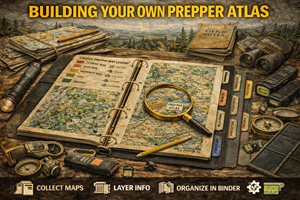
20. Building Your Own Prepper Atlas
Turning maps into judgment, judgment into calm decisions, and preparation into resilience
By now, one thing should be clear: preparedness is not about owning maps — it’s about organizing understanding.
A Prepper Atlas is not a single book or folder. It’s a living system that brings together geography, risk, resources, human behavior, and personal knowledge into one place you can rely on when conditions change.
This final post ties the entire series together and shows how to build an atlas that grows with you, works offline, and supports real-world decision-making rather than fantasy planning.
What a Prepper Atlas actually is
A Prepper Atlas is:
- curated, not exhaustive
- layered, not cluttered
- personal, not generic
- usable under stress
It combines:
- official maps
- your platform’s curated prepper maps
- personal and community knowledge
- annotations and lessons learned
Think of it as situational awareness in physical form.
Why building your own atlas matters
1) Information without structure creates paralysis
The modern problem isn’t lack of data — it’s overload.
A Prepper Atlas:
- filters noise
- highlights priorities
- removes unnecessary complexity
Preparedness improves when decisions feel obvious.
2) Stress rewards familiarity, not novelty
In high-stress situations, people revert to what they know.
An atlas you’ve built and used:
- feels familiar
- reduces hesitation
- supports confident action
A new app or website does the opposite.
3) Maps reveal patterns when organized correctly
Layered maps show:
- where risks stack
- where options remain
- where systems fail slowly
An atlas turns insight into instinct over time.
Core sections every Prepper Atlas should include
Section 1: Local Orientation
- detailed local road maps
- topographic maps
- access points and choke points
This is your immediate decision layer.
Section 2: Hazard Awareness
- flood, wildfire, seismic, and climate maps
- historical disaster overlays
- seasonal risk notes
This section answers: What fails here, and when?
Section 3: Survivability & Resources
- water systems
- soil and food potential
- foraging zones
- land-use notes
This section answers: How does life continue here?
Section 4: Human Pressure & Movement
- population density
- commuter and evacuation corridors
- growth trends
This section answers: Where do people go under stress?
Section 5: Movement & Fallback Options
- bug-out zones
- alternate routes
- staging areas
This section answers: What options remain if conditions change?
Section 6: Personal & Community Knowledge
- hand-drawn maps
- skill and resource notes
- mutual aid information
This is the resilience multiplier.
How to physically build your atlas
Format options
- three-ring binder (modular and expandable)
- waterproof field notebook
- printed packets by category
- multiple copies in different locations
The best format is the one you’ll actually use.
Map preparation tips
- print in grayscale and color where useful
- laminate high-use pages
- leave margins for notes
- include legends and scales
Maps should invite interaction, not intimidation.
How to maintain and evolve your atlas
Schedule updates
- annually
- after major events
- when relocating or changing routines
Preparedness is a process, not a project.
Add lessons learned
After:
- storms
- outages
- supply disruptions
…update your atlas. Experience is the most valuable layer.
Remove what no longer matters
An atlas that grows endlessly becomes unusable.
Cull aggressively. Clarity beats completeness.
Teaching and sharing the atlas
A Prepper Atlas becomes more powerful when:
- family members know it
- group members contribute
- neighbors share insights
It can:
- support drills
- anchor discussions
- preserve institutional memory
This is how preparedness becomes cultural, not just individual.
Common mistakes when building an atlas
- Mistake: copying everything
Fix: curate intentionally. - Mistake: ignoring personal limits
Fix: match plans to reality. - Mistake: never practicing
Fix: use the atlas regularly. - Mistake: storing it in one place
Fix: redundancy matters.
How this completes your platform’s mission
Your Prepper Atlas concept ties together:
- awareness (Prepper Watch)
- planning (maps and guides)
- community (shared knowledge)
It reflects your core belief:
“Preparedness is not fear-based.
It’s responsibility-based, community-driven, and grounded in reality.”
This series now stands as:
- a comprehensive educational guide
- a foundation for printable resources
- a framework for community engagement
- a long-term reference library
Final thought
A Prepper Atlas is never “finished.”
As conditions change, skills grow, and communities evolve, the atlas evolves too. What matters is not perfection — it’s intentional awareness.
Preparedness begins the moment you stop reacting and start seeing clearly.