
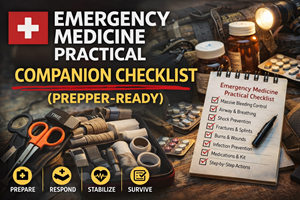
Companion Checklist (Prepper-Ready)
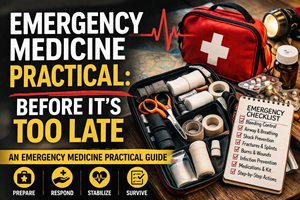
An Emergency Medicine Practical Guide
1. The Reality Most People Ignore
Emergency medicine is not about hospitals.
It’s about time, access, and decision-making under pressure.
In a true emergency:
- You don’t have time to research
- You don’t have ideal tools
- You don’t have backup
What you do have is:
- What you prepared
- What you practiced
- What you remember under stress
Most people assume:
“I’ll just call 911.”
That assumption fails when:
- Systems are overwhelmed
- Infrastructure is down
- You are remote
- You are the only one there
Emergency medicine for preppers is about bridging the gap between injury and survival.
2. The Golden Rule: Time is Survival
There are three critical time windows:
0–5 Minutes
- Airway
- Breathing
- Circulation
Failure here = death
5–30 Minutes
- Severe bleeding
- Shock
- Head injuries
This is where most lives are saved or lost
30–120 Minutes
- Infection risk
- Internal damage
- Stabilization
This is where your skill matters most
3. The Prepper Medical Mindset
You are not trying to be a doctor.
You are trying to:
- Keep someone alive
- Prevent deterioration
- Buy time
Think in priorities:
- Stop dying
- Stabilize
- Monitor
- Transport (if possible)
4. The Core Medical Kit (No Fluff)
Your kit must match reality—not fantasy.
Critical Bleeding Control
- Tourniquets (2 minimum)
- Israeli bandage
- Hemostatic gauze
- Compression wraps
Airway & Breathing
- CPR mask
- Nasopharyngeal airway (advanced users)
- Chest seals
Wound Care
- Sterile gauze
- Antiseptic (iodine/chlorhexidine)
- Medical tape
- Sutures or steri-strips
Medications
- Pain relief (ibuprofen/acetaminophen)
- Antihistamines
- Anti-diarrheal
- Electrolytes
Tools
- Trauma shears
- Tweezers
- Thermometer
- Gloves (lots)
5. Massive Bleeding: What Actually Saves Lives
If someone is bleeding heavily, you have minutes.
What to Do:
- Apply direct pressure immediately
- Pack wound if deep
- Apply tourniquet if bleeding continues
Tourniquet Rules:
- High and tight
- Tight enough to stop bleeding (not “comfortable”)
- Do NOT remove once applied
Mistakes:
- Waiting too long
- Weak pressure
- Fear of hurting the patient
Pain is irrelevant. Blood loss is not.
6. Airway Management (Keep Them Breathing)
If they can’t breathe, nothing else matters.
Signs of Airway Problems:
- Gurgling
- Choking
- Unconsciousness
Immediate Actions:
- Tilt head, lift chin
- Clear visible obstructions
- Place in recovery position if unconscious
Advanced (Optional):
- Airway adjuncts if trained
7. Chest Injuries (The Silent Killers)
Penetrating chest wounds can collapse a lung.
Signs:
- Difficulty breathing
- Sucking chest wound
- Uneven chest movement
Treatment:
- Apply chest seal
- Monitor breathing
- Keep patient calm and still
8. Shock: The Hidden Threat
Shock kills slowly—but reliably.
Signs:
- Pale, cold skin
- Rapid pulse
- Confusion
- Weakness
Treatment:
- Lay patient flat
- Elevate legs (if no injury)
- Keep warm
- Stop bleeding
Shock is often what kills—not the injury itself.
9. Fractures and Immobilization
Broken bones can become fatal if mishandled.
What to Do:
- Immobilize above and below the injury
- Use splints (or improvise)
- Avoid unnecessary movement
Improvised Splints:
- Sticks
- Boards
- Rolled clothing
10. Burns: More Dangerous Than They Look
Burns destroy skin—the body’s defense system.
Types:
- First-degree (red)
- Second-degree (blisters)
- Third-degree (charred)
Treatment:
- Cool with clean water (not ice)
- Cover with sterile dressing
- Prevent infection
Critical Rule:
Large burns = high infection risk + fluid loss
11. Infection Control (The Long Game)
Most people survive the injury—and die from infection later.
Prevention:
- Clean wounds thoroughly
- Use antiseptics
- Keep wounds covered
Watch For:
- Redness spreading
- Swelling
- Pus
- Fever
12. Dehydration & Electrolyte Loss
Often overlooked, but deadly over time.
Causes:
- Diarrhea
- Vomiting
- Heat exposure
Treatment:
- Water + electrolytes
- Small frequent intake
- Monitor urine color
13. Medical Scenarios You Must Prepare For
Scenario 1: Severe Cut While Working
- Apply pressure
- Pack wound
- Wrap tightly
Scenario 2: Fall Injury (Remote Area)
- Check consciousness
- Stabilize spine
- Immobilize limbs
Scenario 3: Food Poisoning
- Hydrate aggressively
- Rest
- Monitor worsening symptoms
14. Training Over Gear
Gear without training is dangerous.
Focus on:
- Basic first aid courses
- CPR certification
- Hands-on practice
Practice:
- Applying tourniquets
- Splinting
- Wound packing
15. Redundancy: Medical Preparedness Layers
You need multiple layers:
Layer 1: Everyday Carry
- Small trauma kit
Layer 2: Home Kit
- Full medical setup
Layer 3: Vehicle Kit
- Mobile emergency response
Layer 4: Bug-Out Kit
- Lightweight essentials
16. Psychological Readiness
People freeze in emergencies.
You must train yourself to:
- Act immediately
- Stay calm
- Focus on priorities
Simple rule:
Do the next most important thing.
17. Common Prepper Mistakes
- Buying gear without training
- Ignoring basic skills
- Overcomplicating kits
- Not practicing under pressure
18. Long-Term Medical Strategy
Think beyond immediate trauma:
- Stock basic medications
- Learn natural alternatives
- Build community medical knowledge
19. Community Medical Preparedness
You should not be alone.
Build:
- Skill-sharing groups
- Medical roles in your community
- Communication systems
20. Final Reality Check
Emergency medicine is not clean.
It’s not easy.
It’s not optional.
When something happens:
- There is no time to learn
- There is no backup plan
- There is only what you prepared
Final Takeaway
Preparedness in medicine comes down to:
- Speed
- Skill
- Simplicity
- Practice
Because when it happens…
It’s already too late to prepare.