
Introduction
 Water, like food, is a fundamental human need—but it’s even more centralized, trackable, and vulnerable to control. In AI-driven governance systems, water is increasingly used as a compliance tool, leverage point, and vector for surveillance. Here’s how water supply has been, is being, and may be used in the past, present, and AI-governed future to bring about social, economic, and political control:
PAST: Water as a Tool of Domination and Dependency (1950s–2000s)
🔹 Infrastructure & Strategic Influence
- Post-WWII Era: Water infrastructure was used to reshape urban planning and establish dependency on central authorities.
- Cold War Projects: Large dams and irrigation systems were often funded by foreign powers to control agricultural output and local loyalty.
- AI Roots: Early military modeling systems included hydrological predictions for resource planning and warfare simulations (e.g., dam bombings, drought destabilization).
🔹 Privatization Begins
- 1990s–2000s: World Bank-backed water privatization plans swept Latin America, Africa, and Asia.
- Effect: Water transitioned from public good to market commodity. Regions that resisted (e.g., Cochabamba, Bolivia, 2000) were punished via sanctions or destabilization.
PRESENT: AI and the Digitalization of Water (2010–2025)
🔹 Smart Meters & Water Surveillance
- Deployment: Municipalities increasingly use AI-integrated smart meters to monitor and restrict household usage in real time.
- Data Harvesting: AI learns household routines via water consumption patterns—showering, cooking, irrigation—all logged and analyzed.
- Leak Alerts → Behavior Alerts: “Leaks” may refer not only to infrastructure issues but to “abnormal” consumption patterns AI flags.
🔹 Preemptive Drought Modeling & Water Rationing
- System: Predictive AI models identify future drought zones and issue restrictions before shortages hit.
- Effect: Rationing can occur months or years in advance, regardless of actual availability.
🔹 AI-Directed Water Pricing
- Dynamic Pricing Models: AI adjusts water prices based on time of day, neighborhood behavior, or social risk profiles.
- Discrimination Risk: “Non-compliant” or low-stability score regions may pay more or receive degraded quality.
🔹 Militarized Water Distribution
- Example: During disaster scenarios, AI-optimized logistics route water to “priority zones,” leaving marginalized areas dry.
- Justification: Efficiency → but it masks algorithmic discrimination and governance bias.
FUTURE: Water in AI-Driven Control Systems (2025–2030)
🔸 2025–2026: Digital Water Access Tied to Biometric ID
- Scenario: Residents must scan facial ID or QR codes to access public water refill stations or pay-per-liter kiosks.
- Result: Unregistered individuals or “risk-tagged” people (e.g., protesters) denied water access.
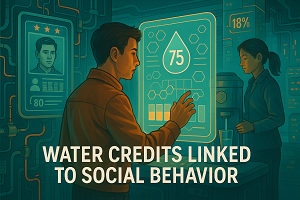
🔸 2026–2027: Water Credits Linked to Social Behavior
- Scenario: Households receive monthly “hydro-credits” adjusted by stability score, energy use, political views, or participation in civic programs.
- Effect: Those who refuse smart meters or participate in protest groups may lose access or receive minimal allotments.
🔸 2027–2028: Geo-Fenced Water Zones Enforced by AI
- Scenario: During heatwaves or droughts, AI restricts water access by geolocation.
- Example: Rural areas near protest zones are declared “non-essential,” shutting off irrigation to enforce compliance.
🔸 2028–2029: Predictive Enforcement & Criminalization of Water Collection
- Scenario: AI predicts which households are likely to install illegal rainwater collection systems or wells.
- Action: Preemptive warnings, fines, or drone surveillance are deployed—potential criminal charges follow.
🔸 2030: Global AI Water Ledger – Mandatory Participation
- Scenario: Participation in a global water credit ledger becomes mandatory. Your usage is tracked, scored, and shared with governments and corporations.
- Outcome: Private wells must be registered, daily usage must be reported, and water storage above “approved” limits becomes illegal.
Why Water Works for Control
| AI Tool | Water Control Function |
| Surveillance via smart meters | Tracks routine, location, and potential dissent activities |
| Dynamic pricing AI | Penalizes specific neighborhoods or social groups |
| Predictive modeling | Enacts rationing before events justify it |
| Biometric access systems | Restricts water based on ID, stability score, or protests |
| Behavior scoring & nudges | Adjusts allotments to reward compliance or punish resistance |
Prepper Strategies to Resist AI Water Control
✅ 1. Develop Off-Grid Water Sources
- Drill private wells or build rainwater harvesting systems (covert if needed).
- Use gravity-fed irrigation and off-grid purification systems.
✅ 2. Store Water Stealthily
- Store water in unconventional containers or underground tanks.
- Distribute your storage to avoid confiscation or detection by drone.
✅ 3. Avoid Smart Plumbing
- Never install AI-linked faucets, meters, or appliances.
- Revert to analog systems wherever possible.
✅ 4. Build Community Water Networks
- Partner with neighbors for shared wells or manual pumps.
- Rotate usage schedules to reduce visibility.
✅ 5. Learn Water Survival Tactics
- Purification: solar stills, sand filters, biochar filtration.
- Foraging: identify natural springs, dew collection, condensation traps.
Summary: “Control the Tap, Control the Territory”
AI will use water just like it uses food—not only as a response to crisis, but as a preemptive behavioral control mechanism. Those who depend on centralized systems will be nudged, scored, and sorted. Those who decentralize and anonymize survive with sovereignty.