
Introduction
 The food supply—one of the most essential and universal human needs—is both a lever of control and a trigger for compliance in the past, present, and projected future AI-driven control systems. Here’s a breakdown of how food has been, is being, and may increasingly be used as a mechanism for global/national influence and preemptive governance.
PAST: Food as a Weapon and Strategic Resource (1950s–2000s)
🔹 Cold War Food Strategy
- Background: U.S. food exports (e.g., grain) were used to influence geopolitics, especially in the USSR and satellite states.
- AI Link: Early AI systems supported logistics, modeling famines, and simulating food aid impact.
🔹 1970s–1990s: Food Aid as Geopolitical Leverage
- Use Case: Governments and NGOs tied food distribution to political alignment or compliance in developing nations.
- AI Seeds: Data modeling and early forecasting systems helped predict droughts, migrations, and food riots.
🔹 2000s: Global Food Chain Digitization Begins
- WTO & Trade Agreements: Centralized food control increased as supply chains became digitized.
- DARPA’s Interest: Systems like PANDA and ICEWS began integrating food shortage data into crisis simulations.
PRESENT: AI in Food Allocation, Surveillance, and Behavior Modeling (2010–2025)
🔹 Smart Food Systems
- Supermarkets and Data: Every swipe of a loyalty card or delivery app feeds AI models for consumer behavior prediction.
- Digital Profiles: Buying patterns can now infer political leanings, prepping activity, and dissent levels.
🔹 Pandemic-Era Food Control
- Event: During COVID-19, AI models predicted shortages and informed rationing policies and lockdown zone supply decisions.
- Key System: AI-informed logistic prioritization determined who received emergency food shipments.
🔹 Food Supply & Behavior Nudging
- Retail AI: Smart shelves, real-time pricing, and geo-targeted ads shape how, what, and when people eat.
- Public Sector: Cities deploy AI to target “food deserts” or “nutrition risk zones,” often masking deeper surveillance systems.
FUTURE: Food as a Tool for AI-Based Preemptive Governance (2025–2030)
Based on our extrapolated timeline:
🔸 2025–2026: Preemptive Food Rationing Based on AI Models
- Scenario: AI predicts civil unrest due to inflation → local authorities preemptively limit food purchases per person.
- Outcome: Food becomes a compliance gateway—only those who scan into the digital ID system can access full rations.
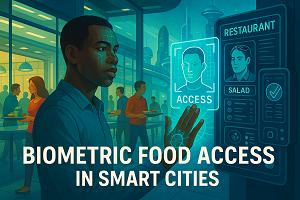
🔸 2026–2027: Biometric Food Access in Smart Cities
- Scenario: Supermarkets require facial recognition for entry or ration tracking.
- AI Use: Models assess who’s “safe” based on purchase history and behavioral scoring.
🔸 2027–2028: AI-Based Resource Triage During Crisis
- Scenario: During a cyberattack or global conflict, AI redirects food away from “non-essential” zones.
- Implication: Autonomous systems determine who eats based on social rank, geographic priority, and behavioral conformity.
🔸 2028–2029: Social Stability Scores Tied to Food Privileges
- Scenario: Citizens with low stability scores (from protest activity or dissent online) receive reduced or delayed food shipments.
- Compliance Loop: “Prove stability → receive basic necessities.”
🔸 2030: Full Integration into Digital Citizenship Score
- Scenario: Access to public food banks, subsidies, or local growers is denied without digital ID tied to social & energy use scores.
- AI Model: A global supply optimization AI determines personal entitlements based on predictive risk and compliance metrics.
How Food Fits into the AI-Control Framework
| AI Control Component | Food Supply Application |
| Surveillance & Profiling | Grocery purchase data = ideological and behavioral indicators |
| Preemptive Governance | Rationing, zoning, and predictive lockdowns based on unrest risk |
| Social Scoring | Food subsidies conditional on biometric ID and compliance level |
| Behavioral Nudging | Algorithmic promotions, restrictions, and penalties via smart apps |
| Crisis Simulation Models | Food distribution scenarios determine response timelines and trust |
| Digital Citizenship | Full food access requires biometric, financial, and ideological alignment |
Prepper Takeaways: How to Stay Food-Sovereign
- 🌾 Localize Food Production: Grow, trade, or raise food outside centralized systems.
- 🪙 Barter-Ready Goods: Store long-shelf staples and tools that can be exchanged without digital tracking.
- 📡 Avoid Smart Supply Chains: Don’t rely solely on app-based groceries or tracked delivery platforms.
- 🧾 Minimize Food Data Trails: Pay with cash, avoid loyalty programs, shop farmers markets.
- 🔒 Stock Before Policy Hits: Assume AI models detect patterns—buy when calm, not when cues emerge.
How Would Preppers Prepare For This?
Here is a comprehensive Prepper Response Plan broken down into 6 key categories, each aligned to the timeline of threats you’ve mapped:
🛠️ 1. Food Independence: Produce What You Eat
Neutralize reliance on AI-controlled food chains.
✅ Actions:
- Build a self-sufficient food system: garden, greenhouse, aquaponics, permaculture.
- Raise livestock: chickens, rabbits, goats—scalable based on land size.
- Save heirloom seeds: avoid genetically tracked or terminator seeds.
- Develop food forests: low-maintenance perennial growing systems.
🧠 Why:
Avoid biometric or digital gatekeeping to food sources. Independent food production breaks the need to “qualify” for rations or stability scores.
🔐 2. Minimize Your Food Data Signature
Starve the AI systems of the metadata they use to profile you.
✅ Actions:
- Use cash or barter for all food-related purchases.
- Avoid loyalty cards, food delivery apps, or subscription services.
- Shop at farmers markets, roadside stands, or local CSAs.
- Keep a burner phone or device offline for market communications if necessary.
🧠 Why:
Grocery and restaurant data feeds behavioral models. AI uses these profiles for preemptive policies, social scoring, and future rationing control.
🏚️ 3. Create Decentralized Food Networks
Parallel systems are your lifeline in crisis.
✅ Actions:
- Build or join mutual aid or MAGs (mutual assistance groups) focused on food.
- Start community gardens with redundancy in tools, seeds, and knowledge.
- Coordinate local food co-ops with informal bartering rules.
- Teach your group how to preserve food (canning, dehydrating, root cellars).
🧠 Why:
When AI redirects resources or food deliveries based on location, risk, or ideology, decentralized community networks will fill the void.
🎯 4. Stockpile Smart – Avoid Detection
Prepare without becoming a data flag.
✅ Actions:
- Buy long-term storage foods in bulk from smaller, non-tracked retailers.
- Stock: rice, beans, oats, flour, powdered milk, canned meat, honey, salt, etc.
- Rotate inventories quietly; avoid panic-buys after AI-model cues hit the news.
- Avoid using traceable IDs or “prepper” flags during online orders.
🧠 Why:
AI pre-crime systems or stability scores may begin to flag bulk buyers as “non-compliant” or potential hoarders. Don’t be a digital outlier.
🔒 5. Harden Against Biometric or Digital Exclusion
Access to food may be blocked without biometric ID or app compliance.
✅ Actions:
- Practice non-biometric access tactics: avoid smart gates, digital ID dependence.
- Learn to use anti-surveillance gear: anti-facial recognition clothing, masks.
- Keep hard copies of documents, manual maps, and local supplier lists.
- Stock offline tools: grain mills, water filters, cooking stoves, analog scales.
🧠 Why:
If a smart city enforces biometric access to grocery or fuel supplies, you’re either in compliance—or locked out. Analog equals freedom.
📡 6. Monitor & Predict the Predictors
Learn how AI systems evolve and use early warning signs.
✅ Actions:
- Watch government tenders, FEMA docs, AI contracts tied to food or health.
- Analyze mainstream language changes (e.g., “equitable food access”).
- Read AI patents or DARPA-funded research for pre-crime food ration modeling.
- Treat food supply algorithm shifts (like adjusted coupons or geo-pricing) as early alerts.
🧠 Why:
AI operates preemptively. If you learn how they plan, you can plan sooner.
Summary Table: Prepper Strategy vs AI-Control Threat
| AI-Control Threat | Prepper Response |
| Predictive rationing and lockdowns | Grow/raise food, rotate stock quietly |
| Biometric gates in smart cities | Use analog systems, avoid entry dependencies |
| Social scoring tied to food access | Avoid public dissent markers, build private networks |
| Food delivery app tracking | Buy local, use cash, disable metadata leak |
| AI resource redirection in rural zones | Form hyperlocal food networks |
| Digital ID dependency for markets | Build off-grid barter and non-digital exchange |
Final Advice: “Control the Calories, Control the Crowd”
Food is one of the oldest levers of power. In an AI age, it’s also one of the most quantifiable and trackable. Prepping isn’t just about storage anymore—it’s about sovereignty.