
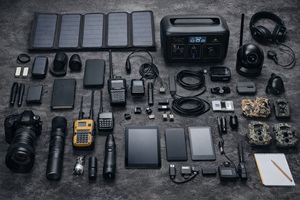
Category: AI & Technology
Focus: Communication • Power • Data • Security • Redundancy
Objective: Build a resilient, real-world tech system that works during normal life AND when systems fail
1. INTRODUCTION: TECHNOLOGY IS A FORCE MULTIPLIER
Technology can:
- increase awareness
- improve efficiency
- enhance survival
But it can also:
- fail instantly
- become unavailable
- create dependency
The goal is not dependence—it’s controlled use
2. CORE PRINCIPLE: TECH MUST WORK OFF-GRID
If your tech:
- needs constant internet
- needs constant power
It will fail when you need it most
Your system must include:
- offline capability
- backup power
- redundancy
3. POWER SYSTEM (THE FOUNDATION)
Essential Gear:
- power banks (multiple)
- solar charger
- portable power station
Advanced:
- foldable solar panels
- inverter systems
Rule:
No power = no tech
4. COMMUNICATION SYSTEM
Primary:
- smartphone (offline-ready apps)
Backup:
- handheld radios (FRS/GMRS)
- HAM radio (advanced users)
Critical Additions:
- offline contact list
- pre-planned communication methods
Communication = coordination
5. DATA STORAGE & ACCESS
Must-Have:
- USB drives
- external SSD
- offline backups
What to Store:
- IDs (copies)
- medical info
- maps
- survival guides
Data is useless if you can’t access it offline
6. OFFLINE KNOWLEDGE SYSTEM
Build Your Library:
- PDFs
- manuals
- maps
- survival guides
Tools:
- tablet or e-reader
- offline apps
Knowledge replaces internet
7. NAVIGATION TECHNOLOGY
Essential:
- GPS device (offline capable)
- offline maps on phone
Backup:
- compass
- paper maps
Never rely on one system
8. LIGHTING & ELECTRONICS
Gear:
- headlamps
- rechargeable flashlights
- extra batteries
Charging Strategy:
- solar during day
- conserve at night
Light = safety
9. SECURITY & PRIVACY TECH
Essentials:
- password manager (offline backup)
- encrypted storage
Advanced:
- VPN (when online)
- secure messaging apps
Protect your data like your gear
10. AI TOOLS (USED CORRECTLY)
AI Can Help With:
- planning
- learning
- troubleshooting
- generating guides
BUT:
- must download/export content
- cannot rely on live access
AI is a tool—not a dependency
11. SURVEILLANCE & AWARENESS
Gear:
- trail cameras
- motion sensors
- portable cameras
Use Cases:
- monitor property
- detect movement
- increase awareness
Awareness = advantage
12. NETWORKING (WHEN AVAILABLE)
Tools:
- mobile hotspot
- mesh networks (advanced)
Reality:
- networks fail quickly in outages
Always assume loss of connectivity
13. REDUNDANCY (CRITICAL)
Always have backups for:
- power
- communication
- data
One failure should not end your system
14. WEIGHT & MOBILITY
Rule:
- portable > powerful
Avoid:
- heavy systems
- complex setups
Mobility = survival
15. ENVIRONMENTAL PROTECTION
Protect Your Gear:
- waterproof cases
- shock-resistant storage
- temperature awareness
Damaged gear = useless gear
16. TESTING YOUR SYSTEM
Before relying on it:
- run without internet
- run without power grid
- test charging cycles
Practice reveals weaknesses
17. COMMON MISTAKES
- relying on cloud storage
- no offline backups
- no backup power
- overcomplicating systems
Simplicity wins
18. REAL-WORLD PREPPER APPLICATION
This system allows you to:
- communicate
- access knowledge
- navigate
- coordinate
Even when:
- grid is down
- internet is gone
This is modern resilience
19. FINAL TAKEAWAY
Technology is powerful—but fragile.
You need:
- control
- redundancy
- offline capability
If your system:
- works without power
- works without internet
You’re ahead of 99% of people