
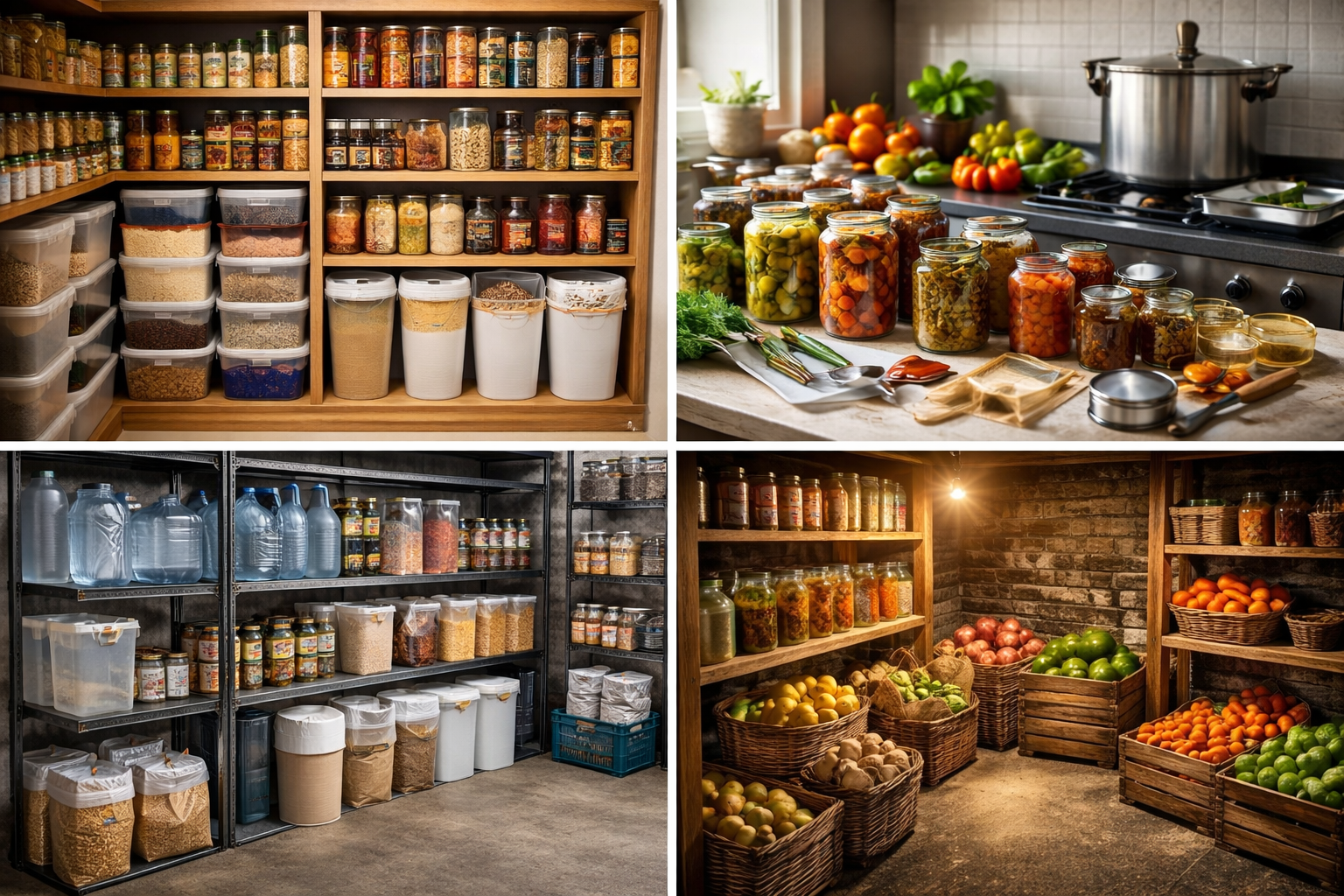
At a basic level, people store food.
At an advanced level:
You build a food preservation and storage system that survives failure, time, and uncertainty
This isn’t about buying more.
It’s about making what you have last longer, work harder, and stay usable.
1. THINK IN “SHELF LIFE CONTROL,” NOT STORAGE
Most people ask:
“How long does this last?”
Advanced thinking:
“How do I EXTEND how long this lasts?”
Key Factors That Kill Food:
Heat
Moisture
Oxygen
Light
Pests
Advanced Strategy:
✔ Cool, dark storage
✔ Airtight containers
✔ Oxygen reduction (Mylar + absorbers)
✔ Moisture control
Rule:
Shelf life is controlled—not fixed
2. BUILD A 3-TIER STORAGE SYSTEM
Tier 1: Daily Rotation
Pantry food
Used constantly
Short shelf life
Tier 2: Medium-Term Storage
Bulk dry goods
Canned foods
3–12 months
Tier 3: Long-Term Storage
Mylar + buckets
Freeze-dried
10–25 years
Why this matters:
Most people skip Tier 2 and create gaps
3. LOW-COST STORAGE THAT WORKS (NO FLUFF)
You don’t need expensive gear.
Budget-friendly setup:
Food-grade buckets
Mylar bags
Oxygen absorbers
Mason jars
Cheap but effective:
✔ Rice
✔ Beans
✔ Oats
✔ Flour
✔ Salt
✔ Sugar
Advanced Insight:
Simplicity beats expensive systems
4. BUILD “WATER-AWARE STORAGE”
Stored food is useless without water.
Categorize your food:
Dry (needs water)
Semi-wet
Ready-to-eat
Advanced Planning:
✔ Store water for food prep specifically
✔ Prioritize low-water foods
Reality:
Food storage fails when water fails
5. ADD MULTIPLE PRESERVATION METHODS
Don’t rely on one method.
Core Methods:
Canning (pressure + water bath)
Dehydration
Freezing (short-term)
Fermentation
Smoking
Advanced Layer:
✔ Combine methods
Example:
Dehydrate → vacuum seal
Can → store cool
Ferment → short-term nutrition
Rule:
Redundancy in preservation = long-term stability
6. CREATE “POWER-INDEPENDENT PRESERVATION”
This is where most people fail.
Ask:
“If power is gone, can I still preserve food?”
Add:
✔ Solar dehydration
✔ Root cellar storage
✔ Fermentation
✔ Smoking
Advanced Rule:
If your system depends on power—it’s temporary
7. BUILD A ROOT CELLAR MINDSET (EVEN WITHOUT ONE)
You don’t need a full cellar.
You need:
Cool
Dark
Stable temperature
DIY options:
Basement corner
Buried containers
Insulated storage bins
Advanced Insight:
Temperature stability extends life dramatically
8. ROTATION SYSTEM (CRITICAL)
Food storage without rotation = waste.
Build a system:
✔ FIFO (First In, First Out)
✔ Label everything
✔ Track dates
Advanced Tip:
Use a simple marker + habit system
Rule:
Stored food must become daily food
9. ADD “FIELD PRESERVATION CAPABILITY”
What if you get fresh food unexpectedly?
Can you:
preserve meat quickly
dry food
can on the spot
Add:
✔ Portable dehydrator (or solar)
✔ Pressure canner
✔ Salt curing supplies
Advanced Thinking:
Preservation = capturing opportunity
10. BUILD “SPOILAGE RESPONSE SYSTEMS”
Food will go bad.
Advanced mindset:
👉 “How do I catch it early?”
Add:
✔ Regular inspections
✔ Smell / texture checks
✔ Separation of risk items
Rule:
Small spoilage should never become total loss
11. CREATE “MODULAR STORAGE”
Don’t put everything in one place.
Break into:
Pantry
Long-term storage
Grab-and-go food
Backup stash
Advanced Advantage:
One failure doesn’t wipe everything out
12. ADD PEST DEFENSE LAYERS
Most people underestimate this.
Threats:
rodents
insects
moisture bugs
Add:
✔ Sealed containers
✔ Elevated storage
✔ Clean environment
Reality:
Pests destroy more food than time does
13. BUILD “LOW-COST PRESERVATION HABITS”
This is where you win long-term.
Examples:
Dehydrate leftovers
Freeze before waste
Compost scraps
Rotate constantly
Advanced Truth:
Habits outperform stockpiles
14. ADD “FOOD VALUE MAXIMIZATION”
Extract everything.
Examples:
Bones → broth
Scraps → compost
Old food → animal feed
Mindset:
Nothing gets wasted
15. PLAN FOR “NO RESUPPLY”
Ask yourself:
“If stores stop, how long do I last?”
Then ask:
“How do I extend that?”
Add:
✔ Preservation skills
✔ Gardening
✔ Local sourcing
Advanced Thinking:
Storage + production = survival
16. HUMAN FACTOR (MOST IMPORTANT)
Under stress:
You forget
You rush
You waste
Your system must be:
✔ Simple
✔ Visible
✔ Easy to manage
Rule:
If it’s complicated, it will fail
17. FINAL ADVANCED RULE
Food storage must degrade, not collapse
Not:
❌ “Everything spoiled”
But:
✅ “We lost some, but still have plenty”
FINAL THOUGHT
At this level:
You’re not storing food.
You’re building:
a long-term supply system
a preservation engine
a waste-reduction loop
Storage buys you time
Preservation extends that time
Skills multiply that time