
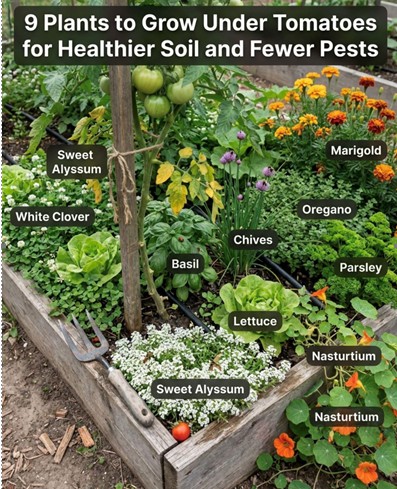
Tomatoes are one of the most popular plants in home gardens, but they can also attract pests, drain soil nutrients, and leave bare ground that dries out quickly.
A simple solution used by many gardeners and homesteaders is companion planting. By growing helpful plants around your tomatoes, you can improve soil health, reduce pests, and even boost production.
Here are 9 plants that work exceptionally well when grown under or around tomatoes.
1. Sweet Alyssum
Sweet alyssum is a powerful companion plant because it attracts beneficial insects.
These tiny white flowers bring in:
Hoverflies
Parasitic wasps
Lady beetles
These insects help control aphids and other pests that commonly attack tomato plants.
Benefits
Natural pest control
Excellent pollinator attractor
Low-growing ground cover
2. Marigolds
Marigolds are one of the most famous companion plants for tomatoes.
They release compounds through their roots that help suppress harmful nematodes in soil.
Benefits
Helps reduce nematodes
Repels certain insect pests
Adds bright color to garden beds
3. Basil
Basil and tomatoes grow extremely well together. Many gardeners believe basil improves tomato flavor, though the biggest benefit is pest deterrence.
Basil can help discourage:
Thrips
Whiteflies
Mosquitoes
Benefits
Natural insect repellent
Culinary herb
Helps fill empty soil space
4. Chives
Chives are a hardy perennial herb that works well in vegetable gardens.
They help deter pests like:
Aphids
Japanese beetles
Their flowers also attract pollinators.
Benefits
Perennial herb
Pest deterrent
Pollinator friendly
5. Parsley
Parsley is a fantastic companion plant because it attracts beneficial insects such as:
Predatory wasps
Ladybugs
Hoverflies
These insects help maintain natural pest balance in the garden.
Benefits
Attracts beneficial insects
Edible herb
Improves biodiversity
6. Oregano
Oregano grows low to the ground and spreads nicely, acting as a living mulch around tomato plants.
Benefits
Helps suppress weeds
Maintains soil moisture
Attracts pollinators
7. White Clover
White clover is a nitrogen-fixing plant. This means it pulls nitrogen from the air and adds it to the soil.
Tomatoes are heavy feeders and benefit greatly from nitrogen-rich soil.
Benefits
Adds nitrogen to soil
Reduces erosion
Improves soil biology
8. Lettuce
Lettuce grows well in the partial shade created by tomato plants.
This makes it a perfect space-saving crop.
Benefits
Maximizes garden space
Helps shade soil
Quick harvest crop
9. Nasturtiums
Nasturtiums act as a trap crop. Many pests prefer nasturtiums over tomatoes.
They attract:
Aphids
Caterpillars
Flea beetles
By drawing pests away from tomatoes, they help protect your main crop.
Benefits
Trap crop for pests
Edible flowers
Beautiful garden addition
Why Companion Planting Matters
When done properly, companion planting can help:
🌱 Improve soil health
🐞 Reduce pests naturally
🌼 Attract pollinators
💧 Retain soil moisture
🥕 Increase food production in small spaces
Instead of growing a single crop in isolation, companion planting creates a small ecosystem where plants help each other thrive.
✅ Prepper Tip
Companion planting is especially valuable for self-sufficient gardening because it reduces the need for:
Chemical pesticides
Synthetic fertilizers
Extra watering
The result is a more resilient garden that produces food reliably year after year.