
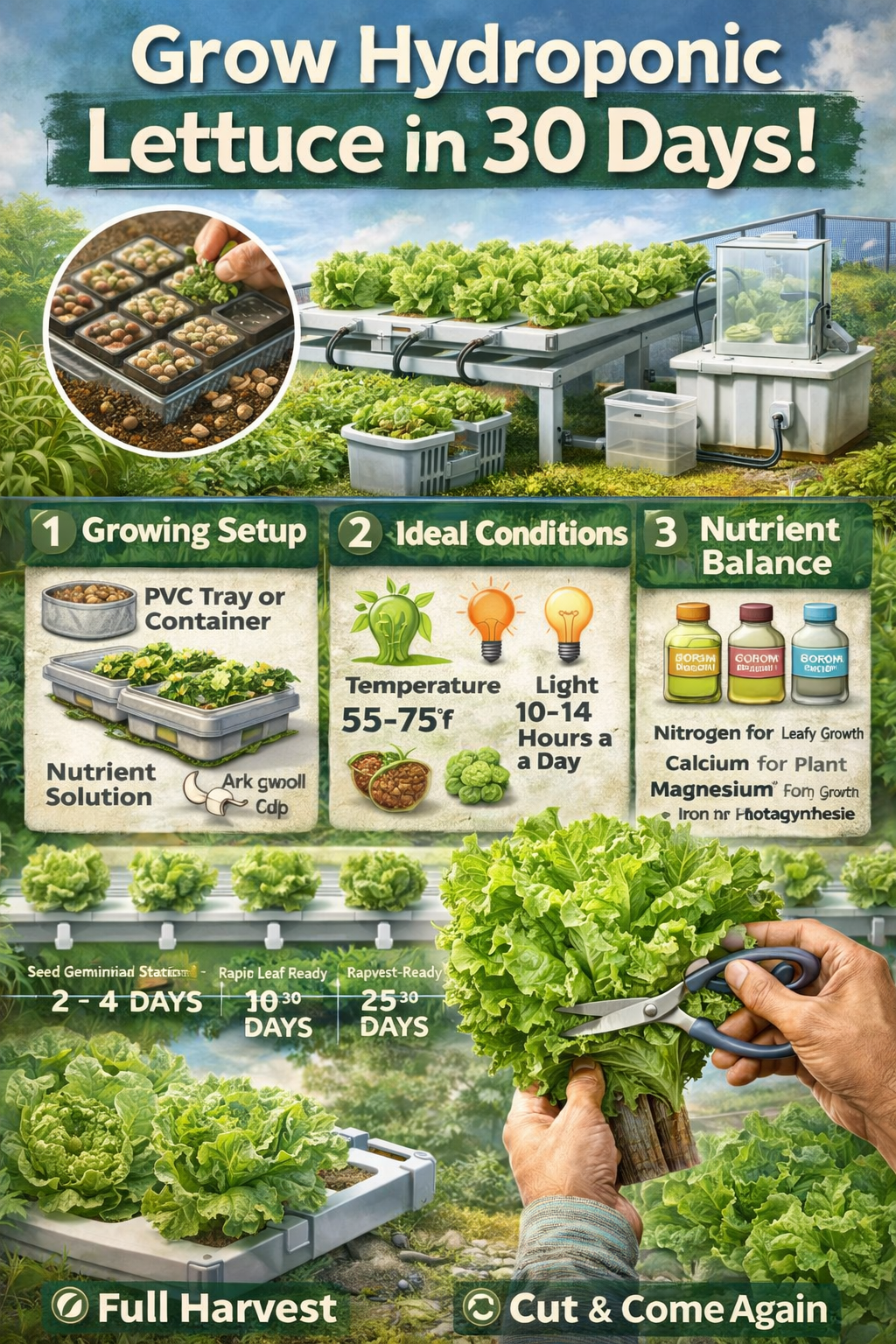
Growing your own food doesn’t always require a large garden or perfect soil. Hydroponic gardening—growing plants in nutrient-rich water instead of soil—has become a popular way for home growers to produce fresh vegetables quickly and efficiently. One of the easiest crops to start with is lettuce. Under the right conditions, it’s possible to grow crisp, healthy lettuce in about 30 days.
Many modern growers are turning to small hydroponic systems because they use less space, conserve water, and often produce faster growth than traditional soil gardening. With a basic setup and a little attention to light and nutrients, beginners can achieve surprisingly impressive results.
🌱 Why Hydroponic Lettuce Works So Well
Lettuce thrives in hydroponic systems because it grows quickly and has relatively simple nutritional needs. Unlike larger crops that require complex root support, lettuce adapts easily to small containers or channel systems.
Benefits include:
Faster growth cycles
Clean produce with minimal soil contamination
Efficient water usage
Easy indoor or outdoor setup
Reliable year-round production in controlled environments
Many home growers are surprised at how forgiving lettuce can be—even when conditions are not perfect.
🧰 Basic Components of a Small Hydroponic Lettuce System
🧱 Growing Channels or Containers
Hydroponic lettuce can be grown using simple channels, containers, or trays. Many small systems use PVC channels or storage containers with holes drilled into the lids.
Typical setup includes:
Containers or rails to hold the plants
Net cups to support the roots
Rockwool cubes or starter plugs for seedlings
Clay pellets or similar media for stability
The roots extend through the net cups and absorb nutrients directly from the circulating water.
💧 Nutrient Reservoir
The reservoir is the container holding the nutrient solution that feeds the plants.
A small home system typically uses:
5–10 gallon reservoir
Air pump with airstones to oxygenate the water
Submersible pump to circulate the nutrient solution
The circulating water continuously supplies nutrients and oxygen to plant roots.
🔄 Water Circulation
Hydroponic systems rely on constant water movement to deliver nutrients evenly.
Common methods include:
Small circulating pump
Gravity-fed return system
Simple tubing connecting multiple growing channels
The goal is steady nutrient flow without allowing water to stagnate.
☀️ Ideal Growing Conditions for Hydroponic Lettuce
🌡️ Temperature
Lettuce prefers cooler temperatures than many other crops.
Ideal conditions include:
Germination: 65–80°F (18–27°C)
Growing phase: 55–75°F (13–24°C)
Keeping temperatures moderate helps prevent lettuce from bolting, which causes bitter flavor.
💡 Lighting
If growing indoors, artificial lighting becomes important.
Recommended lighting schedule:
Seedlings: 16–18 hours per day
Mature plants: 10–14 hours per day
LED grow lights or daylight spectrum bulbs work well for small hydroponic systems.
⚗️ Nutrient Balance
Hydroponic plants depend entirely on nutrient solutions for growth.
Typical lettuce nutrients include:
Nitrogen for leaf growth
Calcium for plant structure
Magnesium for photosynthesis
Trace minerals such as iron, copper, and manganese
Many growers use pre-mixed hydroponic fertilizers designed specifically for leafy greens.
🛠️ Simple DIY Hydroponic Setup
🪛 Building the Growing Tray
A beginner-friendly approach involves using storage containers with holes drilled in the lid.
Steps:
Drill evenly spaced holes for net cups.
Fill each net cup with a rockwool starter cube.
Surround cubes with clay pellets to stabilize plants.
Fill the container with nutrient solution until it lightly touches the bottom of the net cups.
This allows young roots to reach the nutrient solution quickly.
🌿 Starting the Seeds
Lettuce seeds are typically started in rockwool cubes.
Process:
Soak cubes in water before planting
Place one seed in each cube
Keep cubes moist until seedlings appear
Transfer cubes into net cups once roots develop
Seedlings usually sprout within 2–4 days.
⏱️ Growth Timeline
Hydroponic lettuce grows quickly compared to soil-grown plants.
Typical timeline:
Stage
Time
Seed germination
2–4 days
Seedling stage
7–10 days
Rapid leaf growth
10–20 days
Harvest-ready
25–30 days
Within one month, many growers are harvesting full lettuce heads.
🥗 Harvesting Your Lettuce
Hydroponic lettuce can be harvested in two ways.
✂️ Full Harvest
Cut the entire head at the base when mature.
🌿 Cut-and-Come-Again
Harvest outer leaves first while allowing the center to continue growing.
This method extends the productive life of each plant and provides multiple harvests.
⚠️ Common Problems and Simple Fixes
Issue
Possible Cause
Solution
Slow growth
Insufficient light
Increase lighting hours
Wilted leaves
Low water levels
Refill reservoir
Yellow leaves
Nutrient imbalance
Adjust fertilizer mix
Bitter taste
Excess heat
Lower growing temperature
Most problems are easy to correct with small adjustments.
🌍 Why Hydroponics Is Gaining Popularity
Hydroponic gardening is expanding rapidly because it allows people to grow food in places where traditional gardening may be difficult.
Advantages include:
Works indoors or in small spaces
Uses significantly less water than soil gardens
Reduces pest problems
Produces clean vegetables ready to eat
For people interested in food resilience or year-round gardening, hydroponic lettuce is often one of the easiest starting points.
🧠 Final Thoughts
Hydroponic gardening might sound complicated, but lettuce proves that it can be surprisingly simple. With a small system, basic nutrients, and proper lighting, it’s entirely possible to grow fresh salad greens in about 30 days.
For beginners, this fast turnaround provides both a rewarding project and a practical way to produce fresh food at home. Once the basics are learned, the same techniques can be expanded to grow other leafy greens like spinach, kale, and herbs.
Sometimes the most satisfying harvest is the one you grow yourself. 🌱