
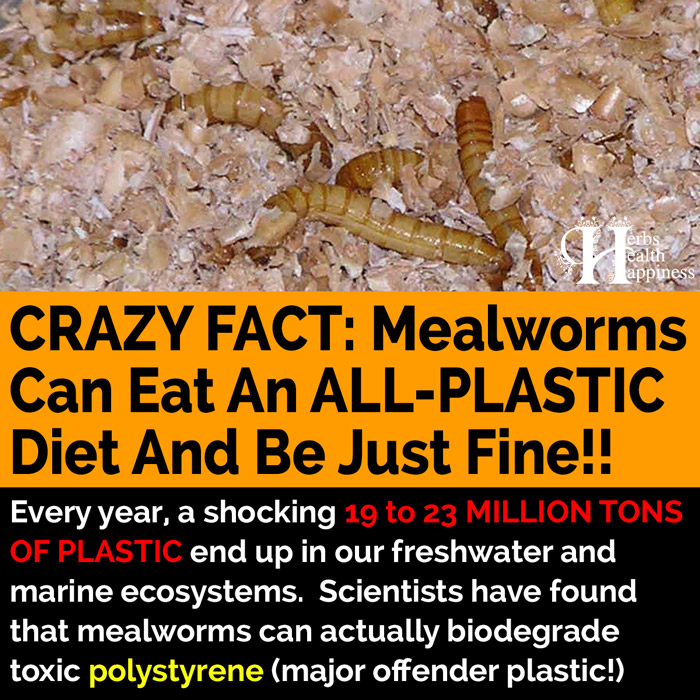
A study by Stanford discovered that mealworms could offer a solution to our growing plastic problem. [1] Two studies co-authored by Wei-Min Wu, a senior research engineer in the Department of Civil and Environmental Engineering at Stanford, revealed that mealworms could subsist entirely on Styrofoam / polystyrene! [2] Apparently, according to Wu’s studies, the mealworm’s gut is filled with microorganisms that are able to biodegrade polystyrene and to some extent polyethylene. [3] The papers were published in Environmental Science and Technology with co-authors Professor Jun Yang and his doctorate student Yu Yang of Beihang University.
In an interview, Wu revealed that their findings are revolutionary. It “is one of the biggest breakthroughs in environmental science in the past 10 years,” he said. He believes that their findings could help solve the plastic pollution problem that is plaguing our world.
Plastic Use Continues To Increase
At the present time, a staggering 450 million tonnes per year of plastic is being produced, up from 297.5 million in 2015 and ~400 million in 2024. [4]
The most shocking statistic? Every year 19-23 million tonnes of plastic waste finds its way into aquatic ecosystems – polluting rivers, lakes and oceans. [5]
Plastics are typically manufactured from crude oil, cellulose, coal, salt, and natural gas. [6] We are so dependent on plastic because it is a versatile, flexible, lightweight, strong, moisture resistant, and relatively cheaper alternative. However useful plastic may seem to us, its major downside is it takes so long to degrade. On average, a plastic bottle takes 450 years to completely degrade, while some bottles even take up to 1,000 years to biodegrade. [7] As a result, our landfills are slowly filling up with plastic and soon, it will become too much to handle. This is where the mealworm comes in.A mealworm is the brown, worm-like larva of the darkling beetle. [8] It is the second stage out of four of the darkling beetle’s life cycle. They exist to eat and grow until the time they have enough energy to begin their transformation into pupae. Mealworms are typically found in warm, dark, and damp places like under decaying leaves and logs. They like to burrow around and will eat grains, vegetation, spoiled food, and other types of fresh and decaying organic matter.
Wu’s research documented 100 mealworms that consumed a total of 34 to 39 milligrams of Styrofoam per day. This is around the same weight as an average pill. Moreover, the mealworms who were exclusively fed Styrofoam were as healthy as those that were eating a regular diet! The worms were able to convert half of the Styrofoam into carbon dioxide. The other half of their waste was worm biomass and biodegradable waste. It may be possible that this waste will be usable in agriculture – but long-term studies are needed before large-scale agricultural use.
Access The Full Article, Click Here